Blog

How to cook beans in Nevada!

You will need: A bucket, water filter, rope, river, ground, firewood, paper, matches, a pot, spices, salt, a grate, rocks, a long stick whittled into a spoon, a large plastic tub of some kind, a water bottle, and beans.

First, take the bucket and the rope to the river. Carefully lower the bucket into the river and fill it with water. Haul the bucket up and take it back to camp.

Pump the water from the bucket through the filter and into water bottles. Take beans, add to large plastic container, and put water over the top. Set in the sun. Spend the next several hours going to town or doing camp chores.

Once the beans are somewhat softened, start a fire in the fire pit. Place the pot over it on the grate. The grate is probably something simple, like a wire rack balenced on rocks or cinder blocks. Put the softened beans in the pot, with more water, spices and salt. Bring to a boil and simmer for a couple of hours.

If you want super deluxe wonderful beans, add rice or possibly hot dog chunks during the last hour. Stir with clean hand-whittled wooden spoon. Boil till beans are soft, place in bowls, and wait for the whole mess to cool down…

Eat for breakfast and lunch the next day, or until you run out, and it’s time to make beans again.

These instructions will also work in northern Idaho.

The Risk of Avoiding Risk

It’s natural to want to avoid risk, whether it is emotional or physical. Sometimes it’s a good idea. But sometimes it can lead to increased suffering down the road. And for some people, like me, it can cripple you.

I’ve found that risk avoidance is just as dangerous as seeking it out. I’ll give an example. It’s just as dangerous to drive too slowly for the conditions as it is to drive too fast. If you drive too fast, you may lose control of your vehicle or hit an obstacle. If you drive too slowly, other people may hit you or get into accidents trying to avoid you. So the best path is (as usual) the middle path.

I was reminded of this when I saw that Richland, a small town in Washington State, has begun removing the swingsets in all it’s school playgrounds. Their reason? Swings are dangerous.

I submit that learning to respond appropriately to danger is important to emotional and mental development. If you sometimes have danger in your life, you learn to either be careful or deal with pain. You learn fortitude and persistence. If you are always protected from all adversity and struggle, you will develop no strength. How strong would you be if an exercise machine did all the work for you? How good with money would you be if you never had to earn any of it?

Emotional risk is especially important to accept. I have had a problem taking criticism, so much so that it has hampered my ability to learn and left me very immature in many ways. This happened because I would always avoid truth that was painful, and take criticism or advice personally, so it hurt so much that I’d ignore that advice. It caused me to completely reject all manner of useful information.

Think about how crippling it would be if you refused to love anyone because you were afraid of losing them. It doesn’t make any more sense to avoid advice or even criticism because you are afraid of pain. I say it because I constantly do it! And every day, I see more and more people who are afraid of risk. The American society seems to be terrified of risk, and avoiding it ultimately makes us weaker and less able to handle struggle or adversity.

We can stand up against fear, and at the same time maintain a reasonable level of safety. The key to all of this is to keep your goal in mind. Adversity builds strength. So don’t try to avoid all risk. Make it okay to be hurt, a little anyway. Being hurt isn’t the end. If you learn to recover from the small pains, the bigger ones will be easier to deal with. Life cannot happen without pain, so it pays to be strong.

Why Tarzan has no beard

In all the movies, TV series, and cartoon shows, comic books, lunch boxes, coloring books and art of all kinds, Tarzan is never shown with a beard. Even though he lives in the jungle and is definitely an adult male!

There’s a reason for that. Are you ready?

He shaves!

Here’s why and how. In the original book by Edgar Rice Burroughs, Tarzan’s parents were marooned on the African coast and died when he was a baby. They had a cabin they had built with some of their things in it. When the baby was rescued by the female ape named Kala, she took him away from that place and raised him.

Later, young Tarzan rediscovered his parents’ old home. He saw pictures of humans and realized that these were his people, not the apes. Not only did he learn to read from the picture books he found, he also learned other things about humans and so he shaved with his knife when he got old enough to grow a beard. I always liked Tarzan because he fought with his wits. He relied mostly on a rope till he got his knife, and though he was strong he knew he was far weaker than the other creatures he lived among. He never killed without need and he had a fine sense of justice.

As an additional point of interest, Tarzan did not live with chimps or gorillas, he lived with a large, intelligent and as yet undiscovered type of anthropoid ape.

The Tale of the Goat-Dog

Our family had a goat when I was younger. A fairly large white Saanen milk goat. She definitely had her quirks and eccenticitries. Her home was somewhat improvised, and we often had difficulty keeping her deer-like little teeth away from our fruit trees, but we had her for years and she was a good friend.

She was a five year old blue ribbon winning 4-H goat when we got her. She had papers and her registered name was Kandoe. As with many high-falutin animals, she had a “barn name,” and we called her Candy. At one poitn I painted “Lieutenant Kan-doe, Officer in charge of Beverage Supply” on the door of the shed where she lived for a while. Her ways were odd, and learning to milk was a strange experience. We made cheese sometimes too.

The fun part was when I would take her for walks around the neighborhood. Our lot was maybe a third of an acre and we lived in a poor neighborhood in the middle of a bunch of other houses. Since forage in our yard grew scarce, and I wanted to supplement her varied needs for browse, I would take her out with a collar and leash. We’d walk by vacant areas with lots of blackberry vines, and down by the beach where the grass was tall, and plenty of other interesting places.

So this is where the “goat-dog” comes in. Once when I was walking her, some kids from the neighborhood asked me waht kind of dog that was! My parents and I were astounded. We were somewhat in the country, after all. How could anyone see a goat, with yellow bar-pupiled eyes, side-pointing stiff goat-ears, pendulous udders, and little flappy tail, and a BEARD, and think this was a dog? Candy was a great goat but she made a really funny looking canine!

Words my Cat Knows

My calico is quite intelligent, or at least I think so. She has a somewhat large head, with an unusually domed skull. And she uses it, too. Last night I said something involving catnip, and she looked at me with bright, interested eyes, and meowed sharply. Like “hey! I want that.” She had been ignoring me before. Here are some other words I’ve known her to understand and respond to cognitively.

Food, bed, dinner, bedroom, Mom, no, okay, out, hi, excuse me, her name of course, toy, mouse, water, litter box, bathroom, couch, chair, and quite a few others.

Interestingly enough, she has learned a few words of Japanese and responds better to them than to English. Fewer hissing sounds.

She’s invented her own ways of communicating too. For example, she will pet you with her tail if she likes you, because she has learned that people pet each other when they like each other. Living with her is like living with a little furry alien who cannot speak, at times. It’s fun!


Illustrating my Novel

A Haunting

It’s late October and time for ghost tales. Here’s one for you, that really made me think.

I was driving home late one night after a long day at the call center. I was looking at the city lights, and the traffic around me, and enjoying the drive. I’m not sure if I was listening to the news or to music, but for some reason my thoughts strayed to my grandfather. For that moment I saw past the withered shell he became at the end. I started thinking about what really important about him. His life, his interests, his skills. I started thinking about what we undoubtedly had in common.

I considered his love for animals, his horsemanship, the fact that when he passed away he received a cowboy’s honors. I thought about his creativity, as crushed as it was at the end. I thought about his truck driving skills. I realized we shared more than I thought, and much of him was passed down to me. In that moment I felt my grandfather’s presence in the car with me, riding along as a silent passenger.

“I forgive you,” I whispered into the dark. “Thank you for what you have given me. I love you, grandpa.”

Haunted Houses

I enjoy a good haunted house. I’ve actually starred in several. In college, I scared the crap out of people by dressing up in my Kendo uniform and full armor, standing as still as a statue, and then letting loose with a loud kiai right AFTER they walked by! I startled quite a few people that way.

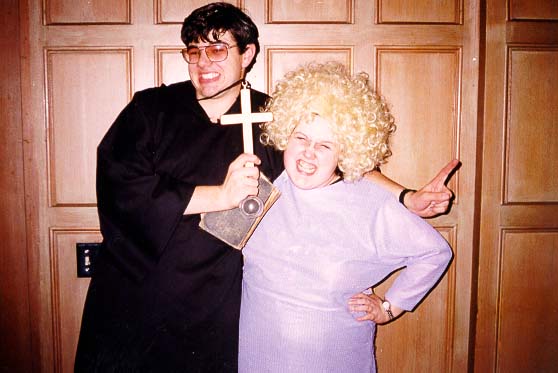
Another Halloween, I was a version of the girl from the Exorcist. A friend of mine dressed in a black robe with a cross and Bible, and I put on this ridiculous dress and blonde curly wig. Some judicious makeup and a crazed grin made me look the very picture of a possessed person. The disguise was so good, my own mother didn’t recognize a picture of me! That’s me, in the picture above. Fifteen years ago.

Later, at the flight museum, I’d dress in full aviator’s kit, complete with flight jacket, goggles, silk scarf,leather helmet, and zombie-whiteface. I’d lie still as a stone until people would come by, then I’d “reanimate” at just the right moment to startle them. I got very good at being absolutely still. I was merciful in that position. If I heard it was little scared kids coming, I’d keep my movements slow and give them a little warning. If it was teenagers or jaded adults, I’d wait till they had just passed by and then I’d let ‘er rip with the full freak factor!

My reward for doing that haunted house was a very special treat… getting to climb up into the cockpit of the TBM Avenger. It was a big reach to get to the footholds, and climb to the top of that grand old World War II bomber, but such a feeling of accomplishment!

Oh, I love Halloween.

Posessed- oogly photo

Essential Tips for Aspiring Writers

I’ve watched the publishing industry change radically over the years, helped publish a few books, and in all of it I’ve seen that certain things remain true. So I have come up with some tips and rules to help protect you from career-breaking mistakes.

Do not ever pay an agent fee or pay a company a publishing charge. Those are used by vanity publishers and scam artists to separate you from your money and give you nothing. I don’t care how good they make the deal look stay away!

If you are an aspiring writer and want to be published traditionally, do not let your desire blind you to scam artists. Get a copy of Writer’s Market, find an agent that will look at your work. Do not pay anyone. Be particularly wary of any unsolicited emails from publishing companies with glowing testimonials, compliments about your work, and promises of big profits. I’m looking at you, SBPRA!

Carefully check any contracts to make sure you retain control over your work. Look for hidden fees. Get someone else to look at it with you if you have to.

When you self publish, and even if you don’t, use a beta reader. Have one or more people carefully read your work, looking for typos, misspelled words, awkward grammar, or anything else that will make your work look less than its best. The more eyes, the better!

Write what you love, write what you know, and never ever write something you don’t know without expert help. That is, talk it over with someone who knows the subject and then listen to what they have to say!

Let me help you, dagnabbit!

I actually like most of my customers. Occasionally I am frustrated because I might actually be able to think of a solution, or at least a temporary fix, but the member is so negative that they won’t accept my offer of “yes.”

Just a friendly bit of advice. I completely understand how frustrating calling customer service can be. But if the rep seems to be halfway intelligent, give them a chance to try to help. It’s what you are calling for anyway, right? Try to refrain from interrupting everything they start to say. I’ll give an example:

A very frustrated fellow came on the line and said “I don’t think you can,” when I asked what I could do to help. This set the tone for the entire call. Every time I tried to think of a way to fix his problem he told me why it wouldn’t work. He often did this before I was even done presenting my solution. I actually had a couple of things I could have tried, but he got so argumentative that I gave up. His own negativity caused his statement to be a self fulfilling prophecy. I try to demonstrate my immediate caring and understanding, because I really do care, but his resistance overcame my best efforts.

What I wish I could have told him at the time: “If you say “you can’t help me” and then interrupt me every time I try to come up with a solution, all my skill and ingenuity will avail you not. I have gotten to the point where I don’t want to argue you into accepting help, when you were asking for it in the first place. So save us both the time and struggle. If you don’t think I can help you, and you intend to stop me from helping you if I do try, then save yourself the hold time and don’t call!”