Blog

Unexpexted Lion Dance

There I was, shopping in my favorite international supermarket.

I was just getting out of the frozen foods section, laden with tasty gyoza and chicken breast. I was checking out the tea section and heading to the front when I heard the most tremendous sound – it was like ten people firing belt fed machine guns at once! The sound went on and on, and it was deafening.

So I stopped where I was, made sure I was near cover, oriented, saw no no one panicking and put two and two together. So that’s what the odd red rope had been! I’d seen it coiled up in a shopping cart and attached to the outside sign of the store as I’d entered. It was a rope of fireworks, for Chinese New Year!

Much comforted, but ears still ringing, I made my way to the front. I wished the nice cashier a happy new year over the noise, paid, and headed toward the entrance–only to find a lion dance starting at the front door!

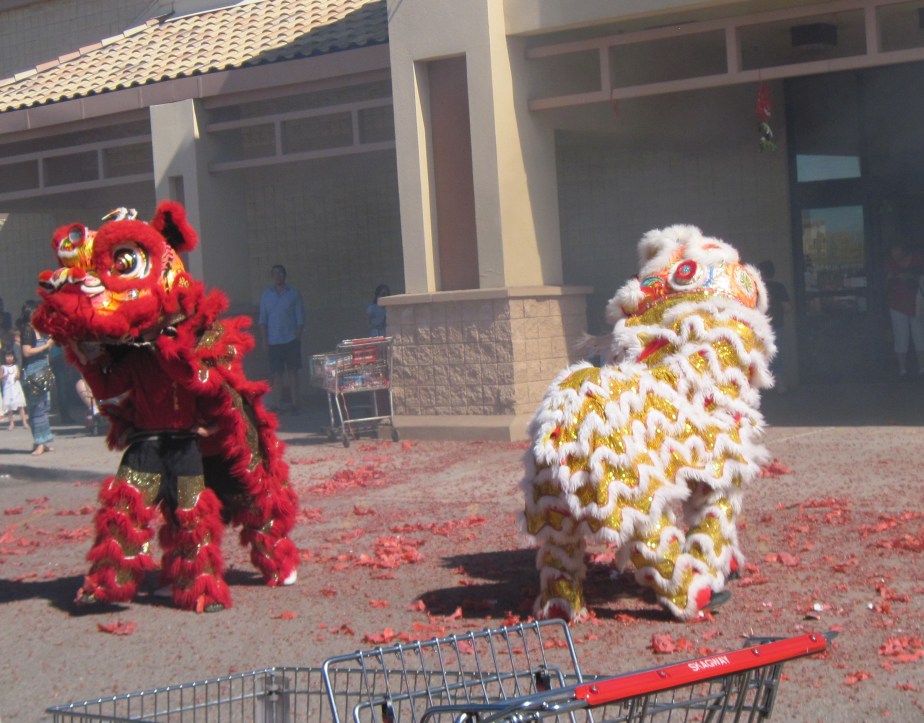
What’s a baffled Westerner to do? Stop, get my cart out of the way, smile and enjoy it! So I did! They had drums, cymbals or something that sounded like them, a red lion and a gold lion both worked by people dancing underneath the costume, a whole group of youths to take over when they teams got tired, and two guys with masks who were fanning at the lions and chasing the bad luck away. Caught up in it all, I had an amazing time.

When I came home a little late I had a really good excuse: “delayed by lion dance.” What an amazing experience. I’m going back next year.


These pictures were taken of this years event, like the one at the beginning of the post.


Here’s one of two ropes of fireworks!Lion Dance firecrackers

Here’s the drummer, preparing to be really loud.

Lion Dance Drummer

Two lions, one red, one gold…

Two Lions

The aftermath, showing all the firecrackers that went off.
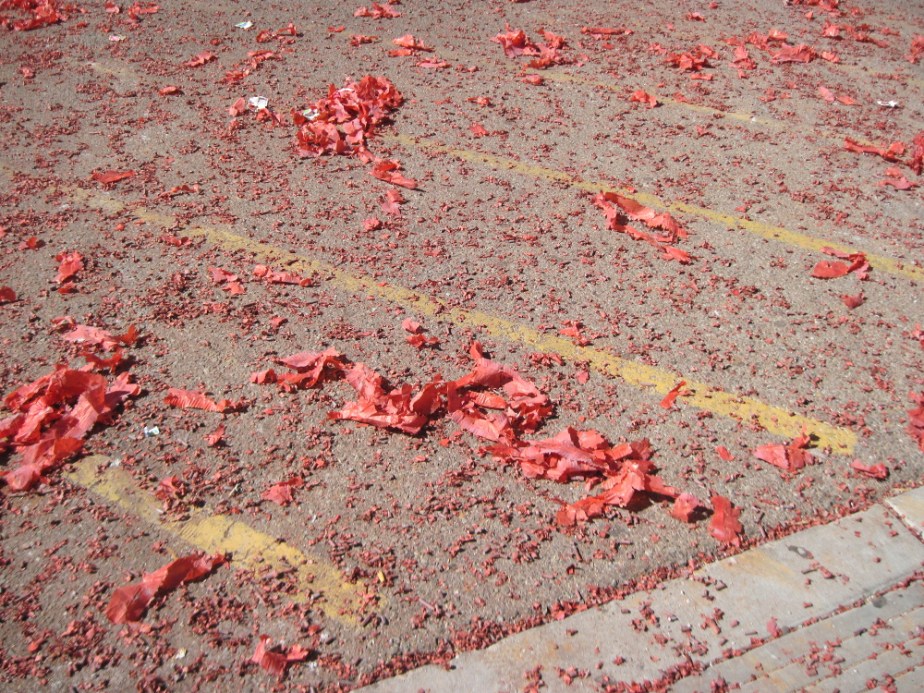
Lion Dance Aftermath

Happy Chinese New Year!

My love affair with Señor Jicama

It all started long ago, when I was little, and my parents kept making up all these funny words, like “gluten” and “hummus.”  My parents were creative!  One of those funny words I heard them say was “jicama.”  But I don’t recall ever trying any.  For years, I didn’t think about it much.  Then I moved to Arizona and learned that jicama was a funny looking brown tuber, sort of like a big round potato or turnip.  And it was always cheap, two pounds for a dollar usually. These days that’s a good price!

I asked around on the internet and found that jicama tastes a little like a water chestnut.

“I can eat a big water chestnut!” I thought. So I went to my local Food City, the place with the great deals and the good music from Mexico playing all the time. That’s  what the Food City in my area does all the time, anyway. I was wondering which one to buy when I had the bright idea to ask one of the friendly produce guys for advice.

“The rougher, the tougher,” he said, helping me select a couple nice, firm jicama. Then he asked how I was going to prepare it. I asked for suggestions. “Cut it up however you want, squeeze some lime, and then sprinkle on some taijin,” he said. “Do you like hot things?” I said I did, very much, and he told how they eat apples that way too in Mexico.

When I got home and tried it, I loved it! Paired with hummus dip, it was even better. It was indeed a bit like water chestnut, a bit like potato, but with a texture more like a crispy apple. The flavor is definitely enhanced by the lime, salt, and red pepper of the taijin powder. I also learned how to peel the jicama to avoid the possibility of belly ache. My
trusty ceramic vegetable peeler worked well, but the larger jicama were easier to peel by cutting off the top and removing the skin in big sheets, then cleaning up the last bits with the vegetable peeler.

I’m still seeing Señor Jicama and we are quite happy together.

Pastels

Along with general tips on making art, I like to introduce different art materials. Sometimes, even if we are experienced artists, we will still benefit by trying new things.  So today, it’s pastels!

Pastels come in several types. There are the oil pastels, which are pigment with an oil base. There are the chalk pastels, which have a drier, more powdery texture. There are also soft pastels that come in little tubs and you put them on with sponge or swab.  You can get pastel pencils too, which are encased in wood.

Paper for pastels should be stiff, at least partly rough, or even sanded. It can be fun to use fine grit sandpaper! You can also use stiff matting board, or light cardboard. The tooth, or roughness, of the paper has a big effect on how your lines look.

For blending, you can use a paper stump, or your fingertip. It’s important to make your blended areas thick and smooth, if you want to avoid patchiness.  An old grungy kneaded eraser can erase with chalk pastels. A latex fingertip cot, used for protecting cut fingertips usually, is good to protect your skin and makes cleanup easier.  There’s my tip for the day!

DickBlick.com has an awesome range of pastels at good prices.

Nothing any government gives you is free

Recently, I read a sentence that included the words “a free gift from the state.”

This is impossible!

It cannot happen, it cannot be done. There IS no such thing.  It’s like expecting the sky to turn purple with yellow polka dots at high noon.

Why is that?

Any government that gives anything to anyone had to get those resources from somewhere. So even if there is no apparent cost to an individual, it had to be paid for in some way. “Free” education is paid for by tax revenue. “Free” healthcare is paid for by more taxes and fees. “Free” welfare is also paid for by more taxes and more fees. Consider also that anything run by any government requires bureaucracy and oversight and is usually full of waste, and therefore is much less efficient than something in the private sector. So it’s ultimately more expensive than a private charity, for example.

I’m not making a statement about the value of programs, I am just making the point that there is no such thing as free when it comes to government.

I mention this because I have seen some people have the simplistic idea that the president of the United States, for example, is like a king who “gives” people things out of his personal money.  That does not happen.

Simply remember, whenever any government “gives” anyone anything, the money had to come from somewhere, and usually at a higher cost because of all the bureaucracy.

Interesting Angles


It’s a simple idea, yet powerful.

If you are drawing, photographing or painting a particular subject, consider a different angle other than a simple straight on view. For a portrait, try it from one side or the other, tilt the head slightly, etc. When depicting a scene, consider a low angle, or maybe even an overhead angle. Think of ways to add interest. The more interesting a picture looks, the more likely it is to stand out in the crowd. Too many people pick a centered straight on view for a portrait rather than a three quarter view, that can look flat and uninteresting.

Different angles can also help convey mood and enhance your message.

Courtesy is Power

Courtesy is one of the best ways we have of affecting the world around us!

With courtesy, politeness, and good cheer, we can have a measurable ripple effect that has lasting consequences. A cheerful smile, a kind word, a sincere compliment, unexpected forgiveness for some small slight, all have an impact that is incredibly powerful. The best part of it is that it spreads. Being angry or sad is contagious too so if we consciously choose a positive attitude (even if we don’t feel it) we can gain better lives for ourselves and benefit everyone around us.

I know I am repeating myself a bit here but I can’t understate the importance of this idea. Consider going through a checkout line. Everybody is tired and hungry. It’s rush hour, and people just want to go home. Think about the difference, and the ripple effect, of behaving in an impatient way versus behaving in a calm, polite way. If everybody is grumpy, everybody stays grumpy. It leads to a worse day with more stress for everyone.

Now, what if ONE, just ONE person in line smiles, says a kind word to the checker, thanks the bagger for their hard work, and makes way for the lady with the walker? Everyone’s day is brightened, just a tiny bit, with no added effort. Maybe the checker with the sore feet smiles at the next customer. Maybe the bagger takes a little more care with the next customer’s eggs. It pays forward and helps everyone.

At work, I do a lot of customer service. 9 times out of 10 I am able to calm an angry customer simply by letting them know that I care about their problem and I want to do anything I can to fix it. Then, even if I can’t fix it, they are often satisfied with me because they understand I did my best. I have seen so many times when an angry person calls up tearing my head off. I listen, I demonstrate understanding and caring, that human connection is made, and we end the call amicably. Then, at home, they have a good memory of someone helping them, they have less stress, and they might be nicer to the next representative they talk to. If I had been rude, that would have been an endless chain. The same is true of my fellow employees. A little friendliness spreads.

It’s a really amazing thing once you start noticing this. People are more positive toward you, you have more people behaving nicely toward you, you get more opportunities, and most importantly, you have an impact on how people treat you. You are no longer at the mercy of the world, you are changing it for the better, just a little bit. Sure there are other ways to make a change but this is a great start.

Lifesaving Tips for Self-Publishers

Here are some hard-won lessons I’ve learned and want to share with you.  They will make your life much easier!

Make your work available as an e-book. This can be easy if you use an outlet like Lulu.com or CreateSpace. Some places, like FastPencil, will let you create and edit online so you don’t even have to stay at home with your word processor.

Price your e-book fairly low.  Remember that you don’t have to work at all when you sell one.

Be aware of current costs of books and don’t price too much below or above the going rate. Above and people won’t pay, below and they’ll say “what’s wrong with it?”

Use a beta reader. The more eyes, the better. You will ALWAYS find something that needs fixing.

When formatting, use full justification when you write. If the print lines up nicely on both sides of the page, it will give a cleaner, neater look. If you don’t know what this means, find out.

When submitting your work, pay attention to the final size of the page and pick a font size that will be readable.  Also, pick a font that is easy on the eyes, such as Times New Roman. A common size for books is six inches by nine, it helps to set your page that way in the beginning so you don’t have to make a bunch of changes later.

Use good word processing software so you can make your work look its best, such as Libre Office. That’s free to anyone with an internet connection.

If you are designing your own cover, avoid clutter and make sure you use an image that is high enough resolution to look good in printing. The company you are working with will tell you the minimum resolution required for images. There’s free image editing software out there, it’s called GIMP and it’s excellent. Like Libre Office, it’s open source and virus free. Both programs come in Windows, Mac, and Linux versions.

Don’t forget to leave room for the barcode and ISBN on the back of your book, if you design that space in, it will look much more finished.

Write what you love, write what you know, and never ever write something you don’t know about without expert help. That is, talk it over with someone who knows the subject and then listen to what they have to say!

And finally, don’t pay for any services unless you know exactly what you are getting!

How to Train your Memory

I have been a chronic sufferer of CRS. That’s short for “Can’t Remember Shit,” of course! Nothing so serious as early onset Alzheimer’s, or anything like that, just a tricky and fickle brain that doesn’t like to hold information.

I’m tired of that. But there is hope. The human brain is like a muscle (no calling me a musclehead) and you can train it. Research has shown that new neural connections are created throughout life, and we can even grow new neurons, something that was once thought impossible after childhood. With this information in mind, I decided to try my hand at improving my brain. So I set myself the task of memorizing various immortal poems that will help build my character. My method was simple. Read the poem several times, write it down a few times, and keep a piece of paper in your pocket and look at it at odd times all day. Rhyming poems are easier to remember, of course.

I found that I would remember more when I woke up then when I went to sleep, because my brain had been busy sorting information and filing all night. Nice to know the sleep scientists are on to something.

So far I memorized Ozymandias by Shelley in three days, while working and doing all my normal things. That bit of paper in my pocket was probably the most helpful thing I could have done, that and saying as much as I could of it, then checking the paper for corrections.

Next is Ulysses by Tennyson. It’s a much longer work but I can already tell I’m having an easier time with it because of the work I did on Ozymandias. If you want to try it too, start with something you really like. It could be a poem, a set of song lyrics, a scrap of a story or article, anything like that. Try to memorize it. It will take at least a few days to do properly.

Some tips for memorizing things:

You will remember the words better if you hand write them at least once, and preferably several times.  For maximum effect, handwrite it rather than printing.

Start small to build up your confidence.  Maybe even just one line.

Read it out loud, read it silently, glance at the piece throughout the day and especially before sleep.

Get plenty of rest. Sleep helps you remember things. You will often find yourself better able to remember after you’ve slept.

Keep at it. It will be hard at first but as you go on, it will get easier!

“And this gray spirit yearning in desire
To follow knowledge like a sinking star,
Beyond the utmost bound of human thought.”
-Tennyson

How to publish a book without paying a cent

You can do it with all the equipment you are currently using at this very moment.

That’s right, just a computer, an internet connection, your brain, and your fingers. Let’s say you have a manuscript. It could be a novel, non fiction, book of poems, biography, cookbook, or whatever. If it’s polished and ready to see the light of day, you already have everything you need!

How can you do this without fancy software or paying publishing fees? Read on.

If you have your text ready, the first thing you will want to do is format it and make sure it includes all the bits you need. Author’s note, copyright, acknowledgements, etc etc. That’s not bad. Then you need to be able to convert it to PDF. One free software program can do all that and it’s called LibreOffice. It’s available for free, and works on Windows, Mac, and Linux. Just gGoogleit!

Many self publishing places want you to put your book in 6 by 9 inch format. That’s easy to do with Libre Office, you can set up the page size so it will automatically be in that size. And when you have your file exactly the way you want it, you can convert it to PDF through the “export to PDF” in the file menu. PDF format is good because it makes sure the book prints out exactly the way you have it set up.

But what about the cover? If you have some artistic or creative talent, you can do it in GIMP, another free program that works for Windows, Linux, or Mac. When you are done setting up the titling and everything, it will also export to PDF format.

Don’t want to draw your own cover? No problem, both of my favorite print on demand sites have a cover wizard that help you make a nice looking cover with very little work.

My favorite print on demand sites are CreateSpace and Lulu. Both support print on demand and ebook options. CreateSpace takes a bigger cut of the profits than Lulu does, but at the same time it gives you much wider distribution options. Both places will assign you an ISBN and let you keep all your own rights in case you should make it big. And neither charges anything for basic set up, they only make money if you sell a book. How much you need to charge to make a profit will depend on how many pages your book is.

My own novel, that I published last year, is 250 pages that are 6 by 9 inches in size. If I charge $14.99 for my book I make just over $5 in profit. That may not sound like much, but it’s a lot better than most authors get with traditional publishing. The Kindle edition makes me more, as I get about $4 per book if I charge $5.99. I like that anyway, because ebooks are great! If anyone would like to see my book, they can search “The Dice of Fate” in the CreateSpace or Kindle eStore.

So there you have it. I published my book and I didn’t pay a cent, and you can do it too.


Dice of Fate cover small

Interruptions


Yesterday I posted about feelings and how people often act exclusively based on them, rather than using their reason.

Today I’m thinking about a related subject and that’s interruption during conversations.  I’ve noticed there are two main ways of communication.  Many people will alternate sentences while they are talking, and feel free to interject short ideas or comments while the other person is still making their point.  This is very common.  Some people take it a step further and will even start talking before the other person is done, finishing the other person’s statements or even drowning them out.

In some places, this is considered polite and even normal.

In other places, it’s more of a paragraph based style of communication.  One person makes a point, the other person waits till they are done and then responds, and it goes on like that.  I see this style in older science fiction and adventure novels all the time.

Not only that, but in every book on communication I’ve seen, the advice is always given to listen to the other person till they are done, and then begin to speak.  It’s also usually mentioned that the best way to listen is with an open mind, while not planning what to say in response.

With that being said, isn’t it amazing how a dear friend of mine, who was raised to believe that interrupting was extremely rude and a social sin, was told that she was actually evil (yes, you read that right, evil) for not wanting to be interrupted?  Yet, if she interrupted anyone she was verbally slapped down.

What this tells me is that people in general need to give up interruptions and double standards!