Drawing: Woman on Beach

Moonlit Beach web


She watches the waves roll in, night wind kissing her skin. The stars shine bright in the sky overhead. Is that a shooting star? Or is that her ship, coming in on its final orbit? She’d thought to steal a few minutes of relaxation between battles, a well earned night of rest, but she senses it will be over all too soon.

The wind plucks at her hair and she moves to rise as a particularly bright streak cuts the sky. That was no meteor.

Observation: The Artist’s Eye

If you are a representative artist, observation is the key to everything. If you take pictures, look at your subject from all possible angles. See things others might miss. If you draw or paint, pay attention to where the light falls, where the shadows lie, how the colors change in your subject depending on when you look at it.

Try different ways of looking at an object, too. Blur your vision and look at the masses, the major areas of color or form. Look at a tiny area of it. Try tracing just the outline of an object, to help you look at the negative space around it. Maybe even pull out a magnifying glass.

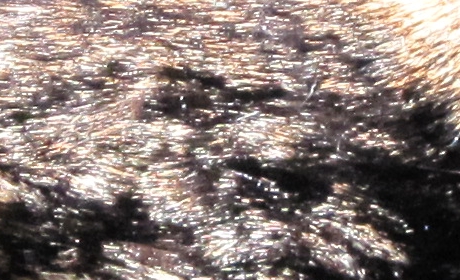
For example, take a look at this photo.  Can you tell what it is?  You could make it into water, or fabric, or a landscape, or take it as it really is – sun shining off cat fur.

How you see is as important as what you see!

Consistent Lighting


Whether you are drawing in chalks or graphite or pastels, painting, or doing pen and ink, pay attention to where the light falls. It can really make or break a piece. When you look at anything, look at what is dark, and what is light, and pay attention to where the light is coming from. Make it a habit to notice.

Before you begin a scene drawn or painted from imagination, decide where the light is coming from. You can create a lot of drama and interest this way. You can convey mood, too, by deciding the type of lighting. Is it strong? Even? Shadowed? Diffuse? What color of light? Golden sunlight of late afternoon? Bright white of an office? Colored, as from stained glass? Soft and diffuse, as from a cloudy day?

Decisions like these can be a great way to add life to your work!

Life – as Art

“You tell your own life’s story. What kind of story do you want to tell?”

I heard words similar to this from my rather wise partner, and I’ve been pondering them. In thinking about how to make my story a better one, I most especially think of the quality of my acts.

Art implies a certain amount of quality and care that goes beyond the norm. The words of a poem are carefully chosen, calligraphy is meticulously done, a painting can have care put into every stroke. Therefore, to make my life into art, to tell my life’s story eloquently and well, I should take more care with my actions.

I can enjoy the artistry with which I drive to work, for example. I can try to avoid sloppiness in what I do. When I speak, I can try to remove clumsy word choices. I can spend a bit more time practicing my handwriting so that it is more elegant. I can cook well, and take an extra moment to plate things appealingly. I can also be intentional about how I spend my time. There are so many ways my life, and yours too, can become art.

What are some of the ways you can imagine this being possible? I welcome your comments.

The Love Purse

I’ve never been a purse wearer, but this is about to change.

A person I met at work turned out to be a truly interesting and impressive person.  He has taught me a fair amount about common sense herbalism, that is herbal therapies that have some real testing behind them, clinical or not.  He’s made the first muscle relaxant salve I’ve ever tried that actually works, and he also makes a healing salve that’s second to none.  He has no patience with homeopathy either, which is a view I share.  He also does all kinds of other things, including bookbinding, map drawing, and now, leather tooling.  It’s nice to know someone who DOES THINGS, MAKES THINGS, things which will endure!

When he was let go at my job, I was pretty mad.  I not only missed my friend, but I knew he had a newborn to take care of.  So when I saw him working on his Etsy shop, including offering some truly lovely leather purses, I was interested.  A holiday present of money gave me the resources to commission him.  At my direction, he made this lovely purse:


purse pic small


I love it.  So that’s the first reason why it’s a Love Purse.  I also love supporting local artists.  And I really, really love buying and using something that is truly built to last – this purse is really sturdy, with no weak points or places it’s going to wear out quickly.  It’s a solid item and I expect to have it for many years.  Also, I love my friend.  He’s a really neat person, full of interesting ideas, and I know he’s a great dad to his kids.  I have respect for him.  I want him to be successful!

So that’s why I also included a link to his Etsy shop.  Just click on the picture to see some really neat leather art, jewelry, herbal remedies, and some other interesting items.

I think I’m going to love carrying this purse.


Art can mean work, but that’s what makes it great!

I just sampled a fabulous blog called “Art is not for Sissies.”  You can find it here, if interested.

https://artisnotforsissies.wordpress.com/

It features art and cats, two of my favorite subjects.  The author is talented but she also takes care with her art.  I’d take classes from her any day!

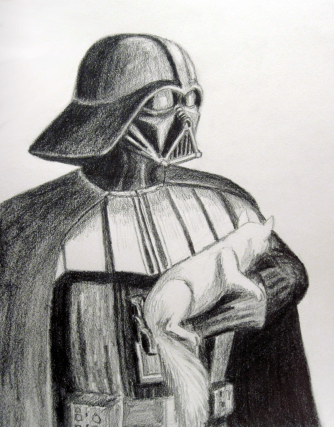
The blog reminded me of a perennial issue I’ve had, one I am in the process of overcoming.  In the past, I have only done art when it was fun.  If the result wasn’t perfect, so what?  It was just art.  I had a few art teachers, some of whom tried to teach me decent studio skills, and others who were more of the “whatever you do is great, follow your own bliss and go with the flow” types.  That latter category of teachers were quite damaging!  This is the kind of work that they inspired:

Vader drawing1

See how I couldn’t keep anything straight, and the pencils are completely inconsistent?  The lighting is off, and poor Vader’s arm is far too large?  That came from “following my own bliss” and not paying attention to detail.

In later years, I’ve ended up with a partner who has a fine appreciation of art and a rather uncompromising view of the world.  She thinks that you should always do your best in whatever you do, and that precision is important.  She pushes me to do better.  I’ve come to love the precision of well done pencils and inks.  I’ve made the clear ruler my friend.  I also know how far I still have to go!  But it’s okay, I have time.

Vader and Kitty

This is what happened when I started caring more… still not great, but better.  He’s distorted a bit, but that was because I was drawing him from memory.  The below image is the point I’m at now.  Not doing much with pencils, in other words!


Bee small

New Year Thoughts: Improving your art


Last time I wrote about the possibility that many artists may choose to settle within their comfort zone, call it their style, and not improve beyond that when they actually have better potential.  This time I’m going to say a few things about getting beyond that point and improving your art, whether it’s visual, auditory, dance, writing, woodworking, or whatever it might be.

I admit it, I’ve been sloppy with my art. Too many times I’ve phoned it in, metaphorically speaking, because I could get away with it. So I am working now on improving my style, my precision, and the quality of my lines. I can be as sloppy as I want in pencils, just as gestural as I choose. But when it comes to the inks, it had better be accurate!

Pen and ink used to be that Thing I Couldn’t Do.  But now I can, at least somewhat.  It helps me most to relax while still staying somewhat alert, and think of drawing all those finicky lines as a meditation. Especially when I am creating shadow, which consists of many, many finely seperated lines. I’ve done a LOT of inking for a recent project and I know it’s been good for me. I’ve noticed that having high quality pens and paper makes a huge difference, if I respect them and use them as they were meant to be used.

For you inkers out there, here’s something else to remember:  With pen and ink, less is more. It’s easy to clutter a scene. Also, it is helpful to make reference lines, erased later, so I don’t go over borders or make things look sloppy. The biggest rule? DON’T GET IN A HURRY.

The main obstacle between me and better art is patience.  You may have different obstacles.  In fact, you probably do.  It’s important that you understand what they are.  Then you can think of ways to overcome them.  For example, I used to have two main obstacles.  The other one was poor materials.    I found ways to buy better materials, made connections, found the best retailers.  So now I just have one thing blocking me and I’m working that.

Good luck to you in the coming year!

Style or Laziness?


I’ve been promising something subversive, implicitly by the title of my blog.  Here’s something that could be a real bone of contention.

Right now I am thinking about art styles – and how people justify them.

Most artists will swear up and down that their style is their style, and that’s how they do art, and that’s the way it is. Period. This holds true for ultra realistic oil painters, just as much as it does for the guys that throw buckets of paint on a canvas on the garage floor. Their art is their art. That’s their style.

I am going to tell you a secret. That’s not always true! Sometimes, artists will settle out at a certain point, stop trying to improve, and do things because they are comfortable with where they are. They do what they are used to, and they do what’s easy.

Why do I say this?  Because I’ve done that.  I’ve done that a LOT. When I look at some of my older stuff I want to cringe. I’m trying to keep raising the bar, not competing with other people but rather with myself. My partner is my cheerleader, drill instructor, and art coach. She keeps me going and doesn’t let me settle for second best. Because of her, I am learning that I can always keep learning no matter where I am.

Once, I saw a woman who had an art sales website. Her drawings were mostly squiggles. She painted a row of trees – they looked like lollipops, open loops of ink splashed over by simple washes of color. But she had a fairly eye catching website and apparently made sales. I use her as reverse inspiration. I want to make my site as good as hers or better, only with well done, crisp art.

I have a long way to go. As long as I’ve been doing art, I still have a long way to go. It takes guts to look at some master of paint or ink and say “I can get there.” But it can be done, first the saying, then the doing. I fail sometimes, I want to give up. It’s too much work, it’s too hard. But eventually I pick up the pen again.

That’s the secret – the next time you see art that doesn’t look like much of anything, it might not really be their “style.” They might not be doing their art that way to be unique. The might be doing it that way because they are either afraid of change or don’t feel like improving!

Food for thought…

Drawing Maps

Drawing maps can be a lot of fun. They look neat and complicated when you are done, but they are really pretty simple, the two biggest problems are keeping the symbols the same and making sure the geology is somewhat logical. Here is how I do mine.

First, I figure out what the land will look like. Will it be a big continent? Part of a continent? Large islands? A tiny archipelago? Sometimes I use real world places for inspiration, or just draw a loose squiggle and refine that.

Then, I look at where the mountains will be. I usually put mine toward the middle of continents, or toward one side, and usually in rough lines. I try to imitate how real mountain ranges grow. I pencil them in lightly at first so I can move them around. When I ink them in, I use a fairly simple upside down v shape with a little shadowing on one side.

I look at the relationship between the mountains and the sea. Using them as a guide, I start to trace where rivers will go, flowing from the peaks down to the sea. I remind myself that streams converge as they flow, instead of branching out. I might put in a lake or two just for fun.

At this point I know where the cities and towns might be – usually along rivers or near bays. After all, people need to get places easily, right? There might be a town near the mountains too, for mining, but usually it will also be near a river. People tend to live near water, not just for travel, but for drinking and crops.

Then you know where the roads are – between cities, or between cities and resources.

And now you know where the forests are too, usually they are thicker the nearer you are to the mountains and the farther you are from people.

You can have fun putting in caves, mineral deposits, castles, swamps and old lonely towers. Don’t forget hills, dry patches, marshland, lighthouses, beaches, rediculously huge cacti, or other embellishments.

The other secret to drawing a good map is this: keep the symbols very simple. That way you can draw a million of them with no strain.

Have fun drawing your map!

Nature Art: Making a Leaf Man

When I was little, my folks took me on nature walks all the time. In the fall, we would walk around and collect colorful leaves, and then go home and make leaf men. They made a nice decoration for the door! Here’s how:

Walk around and gather a bunch of colorful leaves. Enjoy the crisp fall day.

Pick a big leaf for the body, a smaller leaf for the head, long leaves for legs and arms, use clear tape to attach them. It’s a simple project but you can use glue to attack other odd bits to make mustaches, skirts, hats, and almost anything else to your leaf creation. The limit is the imagination. And the fun is enjoying the process!

Finally, hang your leaf man or woman on the door. These usually do better outside, because you are likely to bring little critters in if you hang them inside. It’s a really fun thing to do instead of a wreath!