Blog

Medical Advice – Volume 1

Sometimes I help out on a public medical advice board.  Since these questions are already public, there’s no harm in sharing them here – along with my answers – for hopeful edification and maybe a little amusement.

Q.

Does the radiation emitted by infrared space heaters pose any health risks?

A.
No more than any other kind of heat.  Infrared radiation is just another name for heat, so there’s no health risk.  Provided you don’t overheat yourself, of course.
Q.

are airbrush sets hazardous for your health?

I went to buy an air brush set ( with no paint added, this was just the spray gun) from Michaels.com and there was this warning label that read

“PROP 65: This product contains chemicals known to the State of California to cause cancer, birth defects or other reproductive harm”

is this true? ..are there safer air brush sets out there?

A.

If you get involved with art using real paints and good materials, you will soon note that the State of California thinks pretty much any good pigment is deadly.  Most professional artists routinely use deadly chemicals in their work, but since they aren’t chewing on, ingesting, or breathing their materials they are quite safe.  But the labels will definitely make you worry, so I understand your concern!

The key here is to use the airbrush set with proper ventilation (as you should anyway), spray away from your face, and wash your hands after you use the set.  If you want a little extra protection, wear nitrile gloves.

I do find it odd that the label said just the gun was gun was dangerous, I can’t see how this could possibly be true.   It could be that the rubber gaskets might outgas slightly, but you aren’t sniffing them constantly and you would wash your hands after using the unit.

In short, this unit is likely to be as safe as any other, and if you use it as it is meant to be used there is no danger to you.  Probably keep it out of reach of children, though, just to be safe.

Q.

I saw blood on my finger and licked it. If the person who had the blood is HIV+, can the virus be transmitted to me?

A.

Vanishingly unlikely.  Your saliva is your first defense against viruses.  As you may have heard before, HIV is a pretty weak virus – it dies easily outside the body.  You would have to rub it into an open wound.  Please don’t tell me you also have an open wound in your mouth.

Also, just for hygiene’s sake, what are you doing going around licking other people’s blood off your finger?  And how, exactly are you getting someone’s blood on your finger?  And finally, how in the world do you know they are HIV positive?

Sounds like you are engaged in some pretty interesting activities and you might want to rethink your life.

Of course, you may have a perfectly plausible explanation as to why you are getting HIV positive blood on your finger and licking it.

Q.

is lupus a STD

Can people with Lupus pass in on to their sexual partners
A.

Lupus is a lifelong disorder of the immune system, not an STD.  Here’s some good information about it.
http://www.webmd.com/lupus/ss/slideshow-lupus-overview

Stay tuned for the next issue of Medical Advice!

What is your Purpose?

A good friend told me once that if you know your purpose in life, if you know why you are here, then you will have an easier time staying healthy. You will, in effect, have a greater will to live because you have something to live for.

Some people live for their craft, others live for their children, others for their pets, others for their family. I am still trying to decide why I am here. In part it is to help others, and in part it is to do art – but what kind of art?  Sometimes I seem to lack that fire that gives me passion. I think that is from lacking purpose.

I’ve had trouble with this for a long time.  I just have such a hard time choosing!  It helped to think about the things I did first.  And those things were art, and reading, and wanting to help other people.  If those were my instincts at two and three years of age, perhaps they are important and central?

When I created a list of core values, that helped.   Even just acknowledging why I am here in this life helps me improve, as well as embracing it fully. My friend said that he was 80% certain he was here to heal people, and so he decided to make that 100%. I liked that. It showed that he ws choosing to commit to something. And that is a good lesson for me. I can choose to commit to a purpose, even though I’m not 100% sure.

It occurs to me that this will also help you be happy, as well as healthy.  Having a purpose gives a person not only something to live for but a reason to feel satisfaction in life.  Making a list of those qualities you value most in yourself and others will help cement this.  Ask yourself “if I could do anything, what would I do?”  Then ask, “What are the important elements in that?”

So there. I’ll turn 80% to 100% too.  My purpose in life is to make art and also help people.

Improve your stories with Loss

One of the common themes in stories, both short and long, is the cycle of loss. The character starts out with something. It might be knowledge, a home, a location, a thing, a person. The bulk of the story consists of the character dealing with the loss or change, adapting to it, trying to get whatever it was back, etc. The end of the story, if the story is good, shows the character come to some kind of resolution – growng as a result of the loss, learning something, getting something, having an insight. A good story is not a circle but a helix. The character ends up in a different place than where they began.

This is why some TV shows and book series can be unsatisfying! If everything has be put back the same way it began by the end of the episode, the character can never experience true loss or true growth. Have you ever watched or read something and thought “they can’t get rid of that character so I know they will get out of this somehow.” That’s what I’m talking about.

It’s interesting to look at different stories show what parts of the loss cycle. Cinderella, for example, goes from a bad but normal state, gains something, loses it temporarily, and eventually ends the story in the “gain” part of the cycle. It wouldn’t be as interesting a story if there wasn’t that temporary loss part of the story, where the prince is looking for her and she’s having to deal with her sisters.

War and Peace starts in a time and place of relative prosperty, moves through many phases, most of them involving loss of one type or another, but eventually ends up in a happy place again. The characters grew and changed through their losses and gains.

Black Beauty starts with a place of peace and happiness, goes through loss and troubles, and ends up happy again but with the main character being much wiser.

Most sit-coms start from a place of gain, move temporarily into fear of loss, then go right back to the happy ending without learning anything.

What are some stories you can think of that are like this? Do you ever consider this type of thing in your writing?

Art can mean work, but that’s what makes it great!

I just sampled a fabulous blog called “Art is not for Sissies.”  You can find it here, if interested.

https://artisnotforsissies.wordpress.com/

It features art and cats, two of my favorite subjects.  The author is talented but she also takes care with her art.  I’d take classes from her any day!

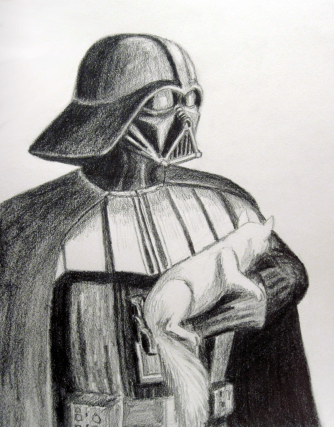
The blog reminded me of a perennial issue I’ve had, one I am in the process of overcoming.  In the past, I have only done art when it was fun.  If the result wasn’t perfect, so what?  It was just art.  I had a few art teachers, some of whom tried to teach me decent studio skills, and others who were more of the “whatever you do is great, follow your own bliss and go with the flow” types.  That latter category of teachers were quite damaging!  This is the kind of work that they inspired:

Vader drawing1

See how I couldn’t keep anything straight, and the pencils are completely inconsistent?  The lighting is off, and poor Vader’s arm is far too large?  That came from “following my own bliss” and not paying attention to detail.

In later years, I’ve ended up with a partner who has a fine appreciation of art and a rather uncompromising view of the world.  She thinks that you should always do your best in whatever you do, and that precision is important.  She pushes me to do better.  I’ve come to love the precision of well done pencils and inks.  I’ve made the clear ruler my friend.  I also know how far I still have to go!  But it’s okay, I have time.

Vader and Kitty

This is what happened when I started caring more… still not great, but better.  He’s distorted a bit, but that was because I was drawing him from memory.  The below image is the point I’m at now.  Not doing much with pencils, in other words!


Bee small

Battling Inertia

Do you ever know you have to do something, but there is so much to do that you get overwhelmed and don’t end up doing anything? This can happen with anything from weight loss to car repair to house cleaning to improving your art or other skills to saving for retirement. But it can be conquered.

The secret is to break everything up into manageable tasks. This has three main advantages. It makes the job seem easier and also helps if time and funds are limited. It also builds your confidence as you do each task. Also, if you give up in the middle of the process, you can at least get some things done!

Here are some examples of how I’ve broken up tough jobs.

My apartment is a mess. Instead of trying to do it all in a week, and getting exhausted, I’ve taken it in stages. I try to clean something each weekend, and tidy up after myself as I go along. So it’s one closet one weekend, another closet the next, shelving unit next, sink next, bathroom sink next, and so on. I get a cleaner apartment but I have time left over for other stuff.

Same with the car. New wipers one trip out, oil change another, vacuuming the interior and airing up the tires anther day, and so on.

It can even work for savings plans. Set a small sum to save every paycheck, pay off small debts, work at it little by little. Small efforts, kept to consistently, do a lot more than big efforts attempted rarely.

And finally, it can work for improving your skills.  Just take it one bit at a time.  For example, art.  You might say “I will draw one picture every day even if it’s just a sketch, and on the weekend I’ll do a project that focuses on my wobbly lines so I have a chance to practice smoother ones.”  It’s so much less daunting than the monolithic “I will improve my art.”

So you’re more likely to do it and break out of that inertia!

New Year Thoughts: Improving your art


Last time I wrote about the possibility that many artists may choose to settle within their comfort zone, call it their style, and not improve beyond that when they actually have better potential.  This time I’m going to say a few things about getting beyond that point and improving your art, whether it’s visual, auditory, dance, writing, woodworking, or whatever it might be.

I admit it, I’ve been sloppy with my art. Too many times I’ve phoned it in, metaphorically speaking, because I could get away with it. So I am working now on improving my style, my precision, and the quality of my lines. I can be as sloppy as I want in pencils, just as gestural as I choose. But when it comes to the inks, it had better be accurate!

Pen and ink used to be that Thing I Couldn’t Do.  But now I can, at least somewhat.  It helps me most to relax while still staying somewhat alert, and think of drawing all those finicky lines as a meditation. Especially when I am creating shadow, which consists of many, many finely seperated lines. I’ve done a LOT of inking for a recent project and I know it’s been good for me. I’ve noticed that having high quality pens and paper makes a huge difference, if I respect them and use them as they were meant to be used.

For you inkers out there, here’s something else to remember:  With pen and ink, less is more. It’s easy to clutter a scene. Also, it is helpful to make reference lines, erased later, so I don’t go over borders or make things look sloppy. The biggest rule? DON’T GET IN A HURRY.

The main obstacle between me and better art is patience.  You may have different obstacles.  In fact, you probably do.  It’s important that you understand what they are.  Then you can think of ways to overcome them.  For example, I used to have two main obstacles.  The other one was poor materials.    I found ways to buy better materials, made connections, found the best retailers.  So now I just have one thing blocking me and I’m working that.

Good luck to you in the coming year!

Style or Laziness?


I’ve been promising something subversive, implicitly by the title of my blog.  Here’s something that could be a real bone of contention.

Right now I am thinking about art styles – and how people justify them.

Most artists will swear up and down that their style is their style, and that’s how they do art, and that’s the way it is. Period. This holds true for ultra realistic oil painters, just as much as it does for the guys that throw buckets of paint on a canvas on the garage floor. Their art is their art. That’s their style.

I am going to tell you a secret. That’s not always true! Sometimes, artists will settle out at a certain point, stop trying to improve, and do things because they are comfortable with where they are. They do what they are used to, and they do what’s easy.

Why do I say this?  Because I’ve done that.  I’ve done that a LOT. When I look at some of my older stuff I want to cringe. I’m trying to keep raising the bar, not competing with other people but rather with myself. My partner is my cheerleader, drill instructor, and art coach. She keeps me going and doesn’t let me settle for second best. Because of her, I am learning that I can always keep learning no matter where I am.

Once, I saw a woman who had an art sales website. Her drawings were mostly squiggles. She painted a row of trees – they looked like lollipops, open loops of ink splashed over by simple washes of color. But she had a fairly eye catching website and apparently made sales. I use her as reverse inspiration. I want to make my site as good as hers or better, only with well done, crisp art.

I have a long way to go. As long as I’ve been doing art, I still have a long way to go. It takes guts to look at some master of paint or ink and say “I can get there.” But it can be done, first the saying, then the doing. I fail sometimes, I want to give up. It’s too much work, it’s too hard. But eventually I pick up the pen again.

That’s the secret – the next time you see art that doesn’t look like much of anything, it might not really be their “style.” They might not be doing their art that way to be unique. The might be doing it that way because they are either afraid of change or don’t feel like improving!

Food for thought…

Two tips for writing fiction

Tip #1:

Get it all down before editing!

I have started many novels and many more short stories. I also have a bad habit of not finishing them!  Luckily, I finally found one of the secrets to finishing them and so I’ll share it with you.

The key? Don’t start editing as you go along. I’ve gotten more done in a shorter time than I thought possible, just by posting on an online site.   (This can be public or private, by the way.)

Why? Because it forces me to keep moving forward. Instead of writing two pages, going back, changing things, editing, and reworking, I write two pages, post them, write the next two, and keep on going. I’ve made a few notes about things to include or change later but I’ve gotten a lot more of the actual story told than I otherwise would have. So keep writing! Don’t stop till you are done, and then go back and polish! You will notice a difference.


Tip #2:

Embrace conflict and confrontation in your stories

Why? Because conflict is what creates drama. Conflict doesn’t have to be argument between people. It can mean an obstacle to the character’s goal. Conflict of some type is usually needed for an interesting story.

Your character is trying to get to grandma’s house, but there is snow in the way and the horse doesn’t want to pull the sleigh. Will your character ever get to grandma’s house? Or will they be able to convince the horse to pull the sleigh?  On the way, what if there are robbers or sheep wearing wolf suits?  Anything could happen.

The challenge to the character creates the suspense, the drama.  If it was a story about how the person got in the sleigh and everything went perfectly, it would be boring, wouldn’t it?  That can be fun for a scene, or to set the stage for something else, but not as a whole story.  You’d think that would be obvious, but can’t we all think of stories where the author didn’t think of it?

Use conflict and confrontation as tools to add spice to your stories.  At the very least, try being aware of the conflict in a story as you read it, and watch how it makes that story more interesting.

Drawing Maps

Drawing maps can be a lot of fun. They look neat and complicated when you are done, but they are really pretty simple, the two biggest problems are keeping the symbols the same and making sure the geology is somewhat logical. Here is how I do mine.

First, I figure out what the land will look like. Will it be a big continent? Part of a continent? Large islands? A tiny archipelago? Sometimes I use real world places for inspiration, or just draw a loose squiggle and refine that.

Then, I look at where the mountains will be. I usually put mine toward the middle of continents, or toward one side, and usually in rough lines. I try to imitate how real mountain ranges grow. I pencil them in lightly at first so I can move them around. When I ink them in, I use a fairly simple upside down v shape with a little shadowing on one side.

I look at the relationship between the mountains and the sea. Using them as a guide, I start to trace where rivers will go, flowing from the peaks down to the sea. I remind myself that streams converge as they flow, instead of branching out. I might put in a lake or two just for fun.

At this point I know where the cities and towns might be – usually along rivers or near bays. After all, people need to get places easily, right? There might be a town near the mountains too, for mining, but usually it will also be near a river. People tend to live near water, not just for travel, but for drinking and crops.

Then you know where the roads are – between cities, or between cities and resources.

And now you know where the forests are too, usually they are thicker the nearer you are to the mountains and the farther you are from people.

You can have fun putting in caves, mineral deposits, castles, swamps and old lonely towers. Don’t forget hills, dry patches, marshland, lighthouses, beaches, rediculously huge cacti, or other embellishments.

The other secret to drawing a good map is this: keep the symbols very simple. That way you can draw a million of them with no strain.

Have fun drawing your map!

Nezumi and the Box

Today, I was packing holiday gifts.  I needed a box to put them in so I bought a new one, still folded flat.

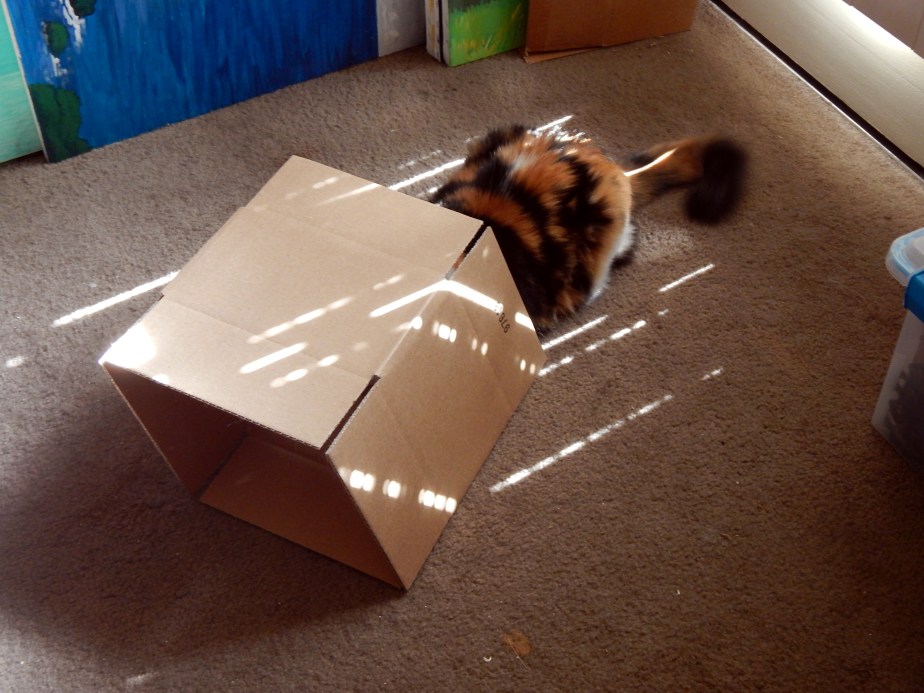
When I brought the cardboard in, my calico began investigating, of course.  First she rubbed her cheek on it.  Then she knocked it down and pushed it around.  Then she tried to unfold the box… I saw what she was doing and opened it for her.  Nezumi loved her new kitty tunnel and had fun walking through it and sitting in it.

The really amusing part (at least to me) was when she then went into her old kitty cave, another cardboard box she’s had for quite some time.  Now I heard her scrabbling around in the back.  It was obvious what was going on.  Having learned about how boxes could be unfolded, and how the flaps came open in the back, she was looking to see if her kitty cave opened that way too!

I love my neko.