Blog

From Subdued to Superb

via Daily Prompt: Subdued


I love taking pictures of the moon, and I finally have a camera that will do it, however the photos are often grainy.  What’s an amateur lunar photographer to do, especially on an evening when there’s obstructions in the way, but that moon coming up over the city is so beautiful?

Photoshop?

Not for me – I use GIMP, the free art program.

Through judicious use of the clonestamp, fuzzy select, gaussian blur, and layers features this subdued image was totally rehabbed.  Clone stamping near parts of the sky got rid of the power line, selecting just the moon itself then putting it on another layer so we could blur the rest got rid of all those speckles, and a simple “white balance”operation cleared up much of the atmospheric haze on the moon itself.

Here’s a better view.

original shopped moon 1000.JPG

shopped - I can't see the pixels 1000.JPG


Inktober Day 15 – The Red Eyes (fiction)

Hunching against the rain, Daphne hurried up the concrete walk till she reached the overhang that sheltered the apartment door. Her battered key rattled in the lock, stuck for a moment, then the knob turned and she was in.

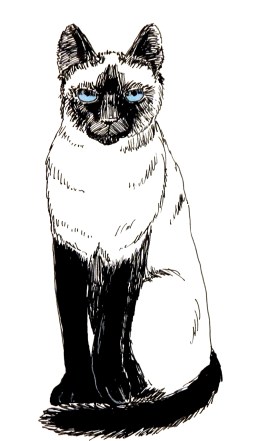
She came inside, shook herself and flipped the light on, looking for her only roommate, the cat. The big Siamese was nowhere to be found, however.

“Dagoba– I’m home– come on out, girl.”

Putting her grocery bags on the stove and taking off her wet sneakers, Daphne padded back into the small living room. She meowed. It wasn’t the best feline impression but usually got a response. This time, though, Daphne didn’t hear an answer. Where is that silly cat? she wondered, her mind already starting to run wild from the stories she’d been swapping with her coworkers on that wet October evening. SHe grunted, lowering herself to the carpeted floor, She got on her hands and knees to check under the couch. That was Dagoba’s favorite spot to hide when the storms were too scary.

“Come on out, Neko-chan,” said Daphne, using her favorite japanese pet phrase for the cat. For some reason, Dagoba sometimes responded to Japanese words more rapidly than words in English. Daphne had wondered before if cats simply liked words that had fewer sibilants in them, but whatever the reason was, right now she just wanted her furry friend out from under the couch.

Two glowing, red eyes shone out from the darkness beneath the padded seat.

Fighting down the jangling from her already frayed nerves, Daphne called quietly. “You got me again, Dagoba,” she said. “Scaring me with those pretty eyes of yours. Come on out from there.”

That was when Dagoba’s warm, round head butted Daphne in the side. She stretched, blinking sleepily, as if to ask “why did you have to wake me up from my nap?”

Daphne glanced over at the Siamese. The cat looked at her curiously, as if wondering why she was on the floor. Her voice shook badly. “You were in the bedroom? Then who’s under there?” Or what? she wondered silently. Her blood was running cold in her veins. She most definitely did NOT want to look at those red eyes again. She got up and grabbed the flashlight that was stuck magnetically to the microwave and turned on its powerful 28 led beam. Slowly, shakily, she got back down on hands and knees. There was no other way to see under the low futon-style couch.

Feeling better with the light, she shone it dagobah-800underneath the couch. There was an old roll of duct tape. A wood saw. Some crumpled up grocery bags. A partial sheet of sand paper. A bottle of white glue, still in shrink wrap. An old radio. Some airsoft beebees. Lint, cat hair. Cardboard. And nothing more.

Dagoba mrowed questioningly.

“Nothing under there, I guess,” said Daphne. “Maybe the airsoft ammo reflected the light somehow?” Even as she said it, she knew it was a lame excuse. But her conscious mind fastened on any halfway plausible explanation. She wanted a normal evening. Life had just been too weird lately. She got up, scooped up her cat and hugged her. Instead of wriggling out of her grasp, Dagoba wrapped her long, brown forearms around Daphne’s neck, licked her cheek, and purred.

Two red eyes under the couch, blinked, waiting.

From the Trenches: Tips for Managers

How do you become a good boss?

My employer is going through a lot of changes due to a recent buyout and it’s made me think a lot about this question. I’ve seen so many problems come up that could have all been solved with a little more of this:
Communication.

Communication can make or break a company. It is one of the primary drivers of employee satisfaction. There can be any number of problems with a company but I know the reason why, and it’s a good one, then it’s amazing what I’ll put up with.

Here’s an example of how this works.

Recently the company started enforcing a strict clean desk policy. My supoervisor told me about this in a brusque way without any explanation. Naturally, I disliked the policy, because I didn’t know the cause.

If my supervisor had taken even thirty seconds to say “We have this new policy and here’s why, can you help me out with this?” I would have been willing, even happy to help. Because the supervisor just told me what to do and not why, I had no chance to become engaged or even want to help out. Result: grumpy employee, grumpy supervisor.

I don’t advocate sugarcoating all information, or undue explanations for everything, however a successful manager will always treat their employees with respect. It doesn’t take brown-nosing or false compliments, it just takes an upright, honest attitude.

More tips for Managers and Supervisors:

Be engaged with your employees. Know how they are doing. Show interest.

Understand the material that your employees understand. That way you know their challenges.

Always recognize success and show interest.

Only reprimand employees in private. When doing so, be honest but not brutal.

Communicate, communicate, communicate. Listen as well as talk.

Develop a team mentality. Instead of saying “do this,” say “this is what needs to happen and why. How can you help me do this?” Obviously that might not always be possible but it’s possible more times than you’d think.

Keep your worries at home. Don’t let them color your behavior.

Don’t play favorites. Develop everyone.

Free book giveaway!

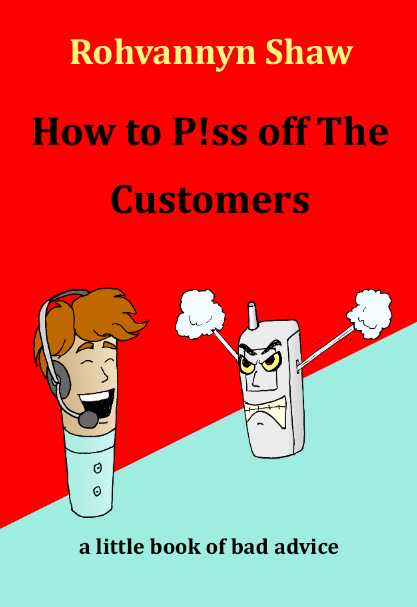
As of today, October 13, and until October 31, anyone in the US can enter to win a free paperback copy of my new book, “How To P!ss Off The Customers!”

It’s a comedic look at customer service’s seamy underbelly, and a guide to being the world’s worst employee.  If you aren’t a member of Goodreads, it’s free to join and there’s no obligation.

If you win this giveaway, I’ll sign the book for you and even pay shipping!  Sorry, international readers, I’ll try to do a better one later but it’s a little expensive to ship worldwide.

Just click on the cover to be taken to the giveaway.

(Please feel free to reblog – spread the word!)


po-book-cover

7 strategies for getting things done

Have you ever started a project and petered out in the middle?
I have. Hundreds of times, maybe thousands.
No one has unlimited energy and enthusiasm. As creative people, we do much better if we treat enthusiasm as a limited resource. We can build it up with use, but it’s still finite.

Here are seven hints to help you use your precious resources well and funnel all that energy where you want it – into your project. This will work for any kind of project but I have one bonus hint especially for writers.
Plan your strategy

If you are an artist, use a concept sketch. If you’re a writer, use an outline. There’s a moment in every project when your idea sits shining, fully formed in your head. Record as much information as you can, while you can. Capture as much of that feeling as possible.

Break up the task

While you are planning, divide the job into pieces. Roughly decide what you are going to do when. Be specific, so if you have to leave the project you can come back to it easily and know exactly where you are. This is great for working opportunistically, especially if you don’t have the luxury of a set working time.

Find the time – or make it

It often seems like we don’t have any time to work, especially distraction free time. However, it’s vital. You might have to tell the kids to go play, feed the cat so she doesn’t pester you, etc. Self discipline is helpful here. Surfing the web when you are supposed to be writing really makes a novel take longer to write, just ask me.
However, even well spent half hour, can be really productive. If you can’t set time aside, work when you can – twenty minutes during a child’s nap, fifteen while the dog is running at the park, an idea jotted down on a notebook while waiting in line at the bank, etc. Get up a little earlier if you have to. Small efforts over time add up. I wrote a novel, at work, between calls.
Treat your creativity and enthusiasm like a finite resource

I mentioned this already but it bears repeating. Don’t pour your enthusiasm into too many projects at once. Focus on a couple of things at a time. This includes things like gaming, social media and work, so balance carefully. If I want to really focus on my next novel, for instance, I’ll cut back on blogging and gaming. That way those mental resources aren’t under so much strain.
Limit brainstorming

This might seem to fly in the face of other advice you’ve read. Ideas are great, vital really, but don’t keep generating them endlessly. If you do, you can feel like you are accomplishing a lot. “Look at all these lists I made,” you may say to yourself. “I’m really making progress.” But, and this is a big “but,” you need to follow through with one of them eventually. Even the best idea means ABSOLUTELY NOTHING unless you follow through.

Don’t talk about your work!

Mention it once in a while if you need, but don’t get into in depth discussions. I’ve found that the more I talk about my latest project, I use up the energy I have to finish it. Everything I have goes into talking about the project so I don’t actually work as much on it. I get tired of the subject faster, I lose enthusiasm. If I stay quiet about it, all that desire to share my project and what’s going on with it gets channeled into the project itself. I get done faster.

Keep going – no matter what

Even when you aren’t feeling creative, don’t quit. If you are writing a novel, try to write at least a few sentences. It may turn into more, it may not, but at least you did something. If you are fixing a car, try to turn at least one bolt. You’ll probably end up doing more. In the meantime, you’ll be developing a good habit. Persistence is more important than talent, every time.

Bonus tips for authors:

Write without editing. Follow your outline, but don’t stop to look at it, just keep going. When I start editing my work before I’ve finis, I end up with far fewer pages than if I didn’t edit. I wasn’t ever able to finish even one novel till I stopped doing that. If you find something that’s a real glaring error, highlight that part of the text or write yourself a note, but MOVE ON. This will keep your momentum up, and then you don’t end up having only a few well polished paragraphs. This helps your “flow” and helps you finish the book.

Wait before you edit. When you’ve finished your project, wait at least a few days before you start editing. Distance is important because otherwise you will miss mistakes. It also helps to look at your project differently. So if you wrote it online, print it out then go after it with a pen. Read it out loud. I catch more mistakes when I do that! Just find some way that your brain won’t be so used to looking at the same words. And don’t forget to refer back to your notes and your outline.


(This article first appeared in another form on Bayart.org, however I reworked it and added new material since then.  So if you’ve read it before, there’s more to find!)

DIY Camera Monopod

I wanted to take a picture of the moon last night the same as I did two nights ago, but it wasn’t in the right position to use my usual trick of bracing my camera on the back fence.  Still, the sheer beauty of the moon as it peeked through the treetops made me find a way, and it worked well enough that I wanted to share it here.

I sat in a chair so that part of me was braced, and for a monopod I used a sponge mop!  It was dry, so no harm done to the camera.  However it worked well enough that I was able to get several shots of the moon.  At maximum zoom, it’s of course rather hard to hold still, and this little help was invaluable.   The spongy texture was stiff enough to support my hands and the camera, and soft enough not to scratch the finish, and the pole handle made a sturdy base that I could angle as I liked.

The featured image shows my result.  Still not perfect, but my camera isn’t a fancy expensive one and I was doing without a tripod or telescope.  I’m happy with it!

Don’t be (quite so) careful

via Daily Prompt: Careful

I was a very careful child.

“Be careful!”  “Don’t drop it!”  “Don’t cut yourself!”

I think I’ve only cut myself once, and that was by accident, when I was carving my best friend’s name into a piece of wood.    I almost never drop things. I’ve never broken a bone.  I’ve never hit another car in traffic.  You could say I’m careful.

But I’m also rather neurotic, ruled by fear, and terrified of taking risks.  I’m overweight because I didn’t run, jump and play enough – in part, I was afraid of getting hurt.  I was careful.  I listened to people too much when I was young.  I didn’t develop a healthy sense of rebellion either.  I learned the fine art of sneaking instead.  “Be careful” turned into “don’t appear to do,” or “don’t try at all.”

Sometimes we need to give ourselves permission to make mistakes.  We need to try new, audacious things.  Stretch outside of the other-made prison of careful.  Take risks.  Move past fear so we can see the other side – then instead of careful, be mindful.

Mindfulness means we think about what we do, we look at it, but we weigh the risks and sometimes we decide a risk is worth it.  It’s being careful in a new way.  The way I did it as a child, it was fear motivated.

“Whatifwhatifwhatif?”

That consumed my young life.

“Well, so what?”

The mistake might not be so bad and the result not the end of the world.

Mistakes can be recoverable.    In the meantime, that scary trip you wanted to take but were afraid to?  Take it.  That exercise class that’s a little too vigorous?  Do it.  Be mindful, and fear won’t rule you.  Sometimes being a little less careful can lead to learning.


Depersonalize, and everyone wins the argument

via Daily Prompt: Argument

I get myself into trouble when I personalize.   This happens when someone disagrees with me about an idea, and I think it’s about me, not the idea.  I start thinking they are attacking me instead of trying to find a solution to something that’s outside both of us.

This has a terrible effect – fights, hurt feelings, raised voices, strained relationships, long periods of moping, and more.  This habit has nearly destroyed me at times.

There’s a way out and through, though.  A discussion of any tough topic doesn’t have end in hurt feelings, no one needs to feel attacked.  The secret is a shift in mindset.

The best way to discuss something is to use arguments, rather than have them.  Think of the discussion as two people working together to solve a common problem.  There isn’t anything personal about it, nobody’s good or bad, the object is for you to work together to find the right answer.

The next time someone disagrees with me, or says something I find difficult to accept, I’m going to shift my focus from myself to the idea.  Thinking logically is the antidote to all the ruin that can happen if I personalize.