Finally, summer’s here! Have some Switchel.

You may be wanting to know exactly what switchel is.   Basically, it’s a mix of water, ginger, vinegar, and sugar.  Sometimes fruit juice is added.

When I first encountered this beverage, I thought it tasted strange. However, the more I drank it, the better I liked it. I learned that it was a common hot weather beverage in Early America, and that intrigued me. I’ll write more about its history later but first, here’s how to make it.

Switchel is simple to make. You start with cold water and add apple cider vinegar, sweetener of some kind, and fresh ginger. It’s refreshing, replenishes your potassium, and helps your digestion. It’s a great recovery drink for after a work out. Though the spicy, sweet and sour flavor may be a bit odd at first, it’s certainly well worth getting used to!

Here’s a good recipe to start with.

1 tablespoon apple cider vinegar, two tablespoons brown sugar, 10 ounces cold water, and minced fresh ginger to taste.  

Variations:

Make ginger tea and add the vinegar and sugar.

Use honey.

Use maple syrup.

Add a splash of fruit juice, such as blueberry or cherry.

Sometimes I will make a strong ginger tea and chill that to make my base with. Other times I’ll simply add chopped ginger to my vinegar-sugar-water mix. Or, as mentioned in the recipe, I might add some fruit juice for variety. I’ve even drunk it warm! Your choice of sweeteners affects the taste. So far I like pure maple syrup or plain white sugar the best. You could also use honey, molasses, or stevia. You may want to limit your sweetener, though I wouldn’t recommend eliminating it at first. Personally, I plan to keep a big jug of it in the fridge this summer, especially during the hot, sticky monsoon months.

Personal experiences:

I have found it to have an energizing effect, somewhat like a mild energy drink. I usually digest things better after I’ve had some, too. I have some digestive issues and the ginger helps the muscles in my stomach and gut move a bit more slowly (link) so I digest things more thoroughly. Plain ginger tea does the same, particularly when I eat the chopped ginger as well as drinking the liquid. My body seems to crave the vitamins that are found in the apple cider vinegar. I tend to like {this brand}, though you can buy it at your local grocery store. If possible, buy it organic with the “mother” still included, though I’ve had great results even with the purified, pasteurized variety.

The history of Swtichel:

As mentioned before, this was a farmer’s drink in early America, but many people liked it. It was believed that the ginger had a warming effect that would lessen the shocking effect of cold water on the stomach, while the sugar and vinegar were there for flavor. It was basically an early sports drink.

Since it’s so easy to make, why not try some today?

If something more traditional is more to your liking, here is how to make a simple ginger beer.

First, start with ginger tea. That’s easy to make – steep chopped ginger in hot water for five minutes or so. Make it nice and strong.

Mix the tea with sugar to taste. Perhaps a cup of sugar for a gallon of ginger beer.

Once it’s cooled to body temperature, add a half teaspoon of yeast. Simple baking yeast is fine.

Evenly divide the mixture into two clean 2 liter soda bottles. Put a slice or two of ginger in each one to strengthen the flavor. Fill the rest of the way with plain water. Leave an inch or so of space at the top of the bottle for “head room.” Cap the bottles tightly.

Leave the ginger beer in the fridge overnight, or until the bottles feel hard. The yeast will carbonate the sweet ginger tea and make it into a simple ginger ale, without building up enough to form alcohol. This makes a great cold drink for a hot day!




via Daily Prompt: Final

https://dailypost.wordpress.com/prompts/final/

Temporary Profit – an open letter to department stores

Many of you are rightfully concerned by online competition. Retailers such as Amazon have taken a lot of your market share. So I have a suggestion to increase your profitability in a way that will endure.

Instead of doing more of what you already do, or engaging in progressively more intrusive and annoying advertising, how about capitalizing on your strengths? The strength of a local store is responsiveness. Workers at a store can answer questions, find things for customers, and set up orders for things not in stock. Knowledgeable, personable employees are the difference between a successful business and a faceless set of walls and aisles.

Central planning is the bane of many shoppers’ existence. How many shoppers have gone into a store to buy something and discovered that it wasn’t available in the style they liked because Corporate didn’t carry it? Usually, that just sends shoppers online because comment cards and suggestion boxes do nothing to put the goods they want in the store.

As a business, why not put the human touch back into the department store and be truly responsive to customers? Then they will have a reason not to send all their money to online retailers.  Engage your workers, encourage them to become experts about what they sell, and encourage them to order what customers actually ask for.   The result may be a slightly lower, but more enduring profit, and more importantly, customer loyalty.

Customer loyalty can be all too temporary when they aren’t getting what they need.  Move with the times and with customer demand, and your future will be secure.


via Daily Prompt: Temporary

https://dailypost.wordpress.com/prompts/temporary/

Two Weeks to Resignation – and a new Lifestyle

Some say your life flashes before your eyes when you are about to die. I don’t know if that’s true, but as my time of resigning draws nearer, little memories of this job keep coming up. That time my coworkers did something sweet, or something funny a team lead said. Little things. How hopeful I was when I was hired, how happy I was to have a job. My frustrations with upper management. Things I’ve learned, both large and small. My ecstasy when I saw a friend come back who nearly died twice, my overflowing joy as I hugged him back into the fold.

This hasn’t been an easy decision. I’ve weighed so many different factors. Distance from home, atmosphere, opportunities for advancement, pay, friendships. I’ve been thinking about it for months. When I finally was offered a good position, I thought it might vanish away like smoke. I even dreamed about it. Yet, it was real, and now only two weeks away. I find myself clearing up loose ends, planning my end. I clean up my work station, decide what saved information I’ll bequeath to my friends, decide where my locker loot will go. It’s like a death. I think I’ll bake something for my friends, including bringing something for the diabetics, to show them how much they’ve meant to me. I’ve spent a lot of time here, after all, and sometimes they feel like a second family.

As I tell people of my decision, they are happy for me but sad to see me go. I feel the same. I will miss so many people. Even though I feel anger at injustice from on high, still I’ve had so many intangible gifts. I tell each person with warmth and regret. I wish management could have improved things, if they had, I would have stayed. But their goals are my goals and mine are mine, and it’s time to go. I intend to make these last days good ones, working hard to serve my callers and train those who will follow me.

I know that someday my memories of this place will fade, I’ll learn new halls and doorways, and new faces will start looking like my family. I’ll be over the rocky ridge and back again in familiar country, but it’s going to take a bit of walking across barren ground, looking for landmarks. For me, nearly seven and a half years is a long time, the longest time I’ve worked in one place.

On my last day I’ll leave with head held high, wishing well to all I leave behind. Right now, I am trying to leave a legacy of helpfulness and good will. And there are two weeks to go.


Postscript:

There was another, somewhat unexpected fruit to that job – inspiration for my book, How to P!ss Off the Customers, which will be made into a second edition soon.  It’s a lighthearted look at the perils of working Customer Service, and available for sale on my Books page. 


via Daily Prompt: Lifestyle

https://dailypost.wordpress.com/prompts/lifestyle/

None will be spared from safety features

I love my car. It’s battered, it has 163,000 miles on it, and it was built in 2006. It’s put up with minimal maintenance, a paper route, a drive across the country while carrying heavy loads, and done it all with minimal breakdowns. It’s a Hyundai Elantra with a standard transmission. Even as old as it is, it can still go from zero to sixty in six or seven seconds.

Driving around in my responsive little car, the windows open to the world, I notice big differences between my car and others around me. I see the newer cars, with their higher stances, their taller doors, their smaller windows, their wide doorposts. My car is fairly low to the ground with big windows. It makes situational awareness easy. There is no navigation system, just a radio/cd player, and that leads to far less distraction.

I drove a rental a couple years ago. It was some kind of compact Chevy. Driving it, I felt so insulated from the road. It was harder to see my blind spots, and the thick door posts were also difficult to see around. The high doors, caused by the side impact airbags, further reduced visibility. The suspension system made the road hard to feel. I felt insulated – which is good, if you aren’t hurtling down the road at forty five miles an hour in heavy traffic.

Ironically, “safety features” cause most of these problems. In fancier cars, there are also lane warning systems, backup alarms, camera systems, GPS of course, and many other distractions. There are also automatic braking systems. As much as I love technology, I don’t trust a computer to know when to brake better than I do, or know when I should or shouldn’t change lanes. Do I need an alarm beeping at me, when I’m already in a crisis? No, I don’t.

The more control a vehicle takes from you, the more dulled your skills become. The harder it is to see and hear the world around you, the less situationally aware you are. I’ve seen enough traffic accidents to know that improved situational awareness would save many lives every year. For example, knowing that I have somewhat bad eyesight, I purposely avoid distraction when driving – not using the phone or texting – to give me more brainpower to devote to looking around me. I have avoided so many accidents that way!

The key to being a good driver is improving your ability, not relying on a bunch of safety features that may or may not work. Modern cars often give up real safety in exchange for increasing the driver’s perception of safety. So if a government ever tries to force me into a modern vehicle with all the bells and whistles, then I’ll develop a sudden interest in historical pieces, or build my own!

https://dailypost.wordpress.com/prompts/none/

via Daily Prompt: None

Ownership versus Right to Use

I remember what it was like when everyone was used to owning things. Increasingly, the trend is to pay for the use of something, but it’s not really yours. We rent houses and apartments, lease cars, and buy computers that lock us out from changing anything.

I remember a time when you could do what you wanted with what you bought. You controlled what you paid your hard earned money for. You could modify it, upgrade it, get rid of it, or fix it over and over. No warranty stickers to dissuade you, no secret wiring diagrams not available to the general public, and it was all put together so it could be taken apart again.

If you bought a computer, for example, you could get into the BIOS and change basic settings. You could upgrade or downgrade the operating system as you chose. And when you bought a piece of software, you bought it. You could use it for as long as you wanted. Ownership IS control.

Now, increasingly there are Windows chipsets that try to lock you in to one operating system. They stop working if you change it. Certain operating systems won’t even let you revert to earlier versions unless you want to completely wipe your hard drive. If you own something that doesn’t let you change it or alter it, can you really say you own it? Control is taken away from you, the buyer.

Software is also becoming a pay for use type service. You pay a yearly fee to use your software, even after buying it in the first place!  Then, companies reserve the right to mine your information if you’re connected to the internet, just like certain modern OS’s like Windows 10. Once again, you don’t truly own it, you just pay to use it, and the people who own the software get most of the benefit.

If you lease a car, you don’t really own it either.  Even if you own one, many modern cars aren’t serviceable by the owner, so if something goes wrong you have to bring it to a dealership or an expensive certified mechanic. You are forced to pay for services. Your vehicle becomes just another way for manufacturers to siphon money from you, and keep on siphoning it from you in the future.

That’s why I won’t buy a brand new car. That’s also why I won’t use Windows 10. I’ll use Windows 7, or Linux, but I demand the ability to adjust or fix what I own. I am interested in creating and producing, not being a cash cow for someone else. That’s also why I use ad blockers – so I won’t be data-mined so easily. I’m tired of giving up control. I won’t use subscription software, except for one program which is the best spyware and virus blocker I’ve yet found, and only costs $15 a year. I use open source software like LibreOffice and GIMP. I don’t use Mac products.

I vote with my dollars.

I hope others will too.


https://dailypost.wordpress.com/prompts/control/

via Daily Prompt: Control

Blogging from the blanket – feline telepathy

Mom changed her password again but I figured it out.

How did I figure it out? I can read her mind. Today I’m going to share a great feline secret. Cats, you see, are telepathic. There aren’t always a lot of thoughts to read in the average two legged, usually boring stuff like buying food and going to work and when the mail is coming, and hardly ever anything about mice or birds, but we can read them all the same. That’s how we know it’s time for bed, or time to get up, or time to go to work, or come home, or when our two-legged isn’t feeling well.

Mom is somewhat smart sometimes. The other day I was worried about my friend Thomas. He wasn’t in his usual spot in the window and every time I tried to talk to him I just got hurt-sick feelings. And then he went to The Vet. He even stayed away overnight! Feeling what he was going through made me feel pretty bad myself. But Mom figured out why I was sad, and she came to talk to me. She petted me and she told me Thomas would be okay.

Sure enough, a couple of days later, Thomas was there again, looking out his window at me. Our front windows are kitty-corner from each other, so we can see each other to talk. He gave me the slow blink to let me know he was okay. I purred and purred. Mom saw me looking and purred too, in her own way. Even Thomas’s Mom and Grandma were happy! I heard Mom tell Other Mom about it.

Mom did such a good job worrying about Thomas and understanding me that I figured I’d give her a break and write a blog entry for her.

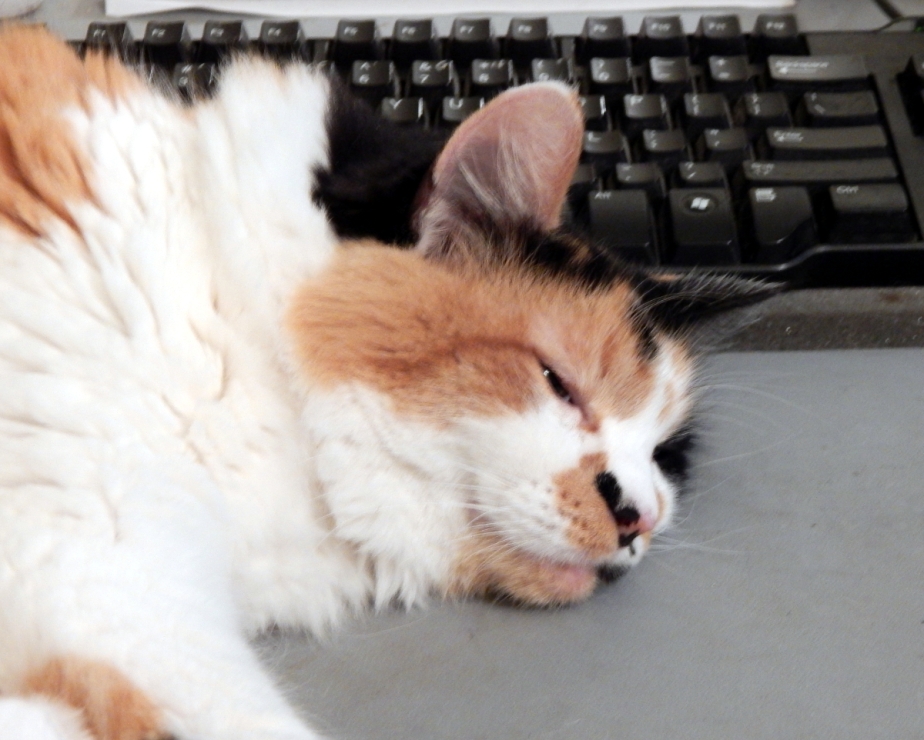
nezumi-keyboard-2

Cat-Mom’s Note:

Our girl Nezumi really did act sad when Thomas was sick.  Was it a smell?  A half-heard conversation?  Simply his absence in the window, that really is kitty-corner from us?  I’m not sure.  I do know that she was moping for a while, and really did perk up when I told her Thomas was being cared for and would be okay.  He needed a night in the hospital but he’s back to his old self again.

On another occasion, I had a very old dog.  She was mostly blind, mostly deaf, and was at that sleeping-most-of-the-time stage.  We loved her dearly but she was nearly at her end.  One night, she woke up from a sound sleep, barking with all her old fervor and running to the back of the house.  All the doors were closed.  I went out, because it seemed she was barking in the direction of the chicken coop.  I opened the back door, ran the fifty yards or so to the coop, and found raccoons attacking the hens.  How had the old dog known?  Closed doors, closed windows, senses nearly gone.  Yet, she knew.

I could go on with stories of how my cat Orion used to wait for me, looking to the east, when I was away to an eastern part of the state, several hundred miles away.  Or how he always knew when I’d be home, and was there to greet me, even if I was early or late.  Keen senses?  Perhaps.  Who knows?

via Daily Prompt: Blanket

https://dailypost.wordpress.com/prompts/blanket/

Be remembered – Make your Mark

Life is interesting. We each only have one at a time, and yet we all know people who waste theirs waiting for it to begin.  I certainly have!

When I was growing up, the formula seemed pretty simple. You grow up, learn about life in school, along with things you need to know like math and writing and social studies and history and all that. You go to college because going to college means you get a degree, and nobody gets a good job without a degree. You might get married. You might have kids. You get a succession of better jobs until you are doing more of the things you want to, then finally you start doing what you were really meant to, and when you retire you can relax all day doing the things you always wanted to do but never had time for.

Not only is that model untrue for quite a few people these days, but it’s also a great waste of time! None of us know how long we’ll have. None of us know how successful we’ll be. Isn’t the main point of life making some kind of mark so we’ll be remembered?

Some people make their mark by having kids. Others do it by starting a charity. Others do it by defending their country. Others do it by having a business. Others do it by writing books, or making art, or writing wildly successful blogs. Others teach. Some people do a bit of all of these. Some do none of it but come up with some other interesting thing. Some wait, because life hasn’t really started.

Life started when we took our first breath.

Every day is a chance to live our dream, make our mark, follow our purpose. The key is making small steps. One day, I realized I was writing a bit every day and could put that effort into a book. I wrote a novel and published it several months later. I learned a lot about writing and publishing. The point isn’t that I wrote a novel, the point is that I did it in bits, by consistent effort. I”d thought previously “someday I’ll be a writer.” Since someday never came, I decided to become one.

We don’t have to wait till we “have it all together” to make our mark.

Since I have no idea how long I’ll live, and neither does anyone else, doesn’t it make sense to start shaping our lives how we want them? There’s always some small thing to do, even if we don’t have time, even if we don’t have money. Mindset is the truest key – if you are determined, you will make opportunities for yourself. Focus will allow you to see the little places where you can make your life a bit more like your ideal image of your life.

In the mean time, I’ll keep working on my blog. If I can touch even one or two people, inspire someone, help someone, or make someone think, then I’ll have made a mark.

Wondering where “Gray” features in this?  Well, in writing about this subject, I thought also of another poem all about making one’s mark – this snippet of Alfred, Lord Tennyson’s Ulysses:

Little remains: but every hour is saved
From that eternal silence, something more,
A bringer of new things; and vile it were
For some three suns to store and hoard myself,
And this gray spirit yearning in desire
To follow knowledge like a sinking star,
Beyond the utmost bound of human thought.


via Daily Prompt: Gray

https://dailypost.wordpress.com/prompts/gray/

A Harmonious Job Interview

Quite a few people are frightened of job interviews.  Here’s how I got over that fear.

I started thinking in a more harmonious way.  I realized, once and for all, that the employer wanted to hire me almost as much as I wanted a job.  All I had to do is show the interviewer how I fit their position.  This doesn’t work a hundred percent of the time, of course, but it removes a lot of stress from the interview process and increased my success rate.

When I go in to interview, the first thing I do is keep a small smile plastered on my face.  My head is up, I’m looking around, I’m friendly with everyone.  If anyone asks how my day is going, I say “great, how’s yours?” or something similar.  I move like I belong there.

When I actually speak with my interviewer, I’m warm and friendly, and I keep in mind that they are just doing their job.  I am thoughtful about my interview responses and I try to inject just a bit of a sense of humor into them.  When I have done the job before, I use that to ask good questions and build rapport.

Yesterday I used this technique to get a job offer.  Not only that, but it was a pleasant, even fun experience, both for the interviewer but also for me.


via Daily Prompt: Harmony

https://dailypost.wordpress.com/prompts/harmony/

Frying in Tucson

The dry season is upon us.

In Arizona, it lasts from late fall through midsummer pretty much.  Summer contains the wonderful, fickle, thunder-filled Monsoon.  But the rest of the year is pretty dry.  Now, in mid to late April, we’re warming up nicely.  Soon it will be time for me to be careful when touching the steering wheel of my car.  I’ve gotten blisters before.  Right now my swamp cooler, an evaporative device, is working very well.  It’s a cheap form of air conditioning – a fan blows air through something like a damp sponge to cool the air down.  So it won’t work in high humidity.  Right now if we run the thing full blast we can get the house down to sixty degrees or so.

doorway-crop-1000

In Tucson, keeping cool is an art form.  Sure, you could sit in a modern home and turn on the air conditioning.  Yet, it’s much more fun to find a shady spot, perhaps in a wonderful old adobe building, with open archways to let in the breezes, and sip some cold agua fresca or maybe some real Mexican Coke in the glass bottle.  Yes, it is better.  Maybe a bowl of ceviche when you get hungry.  Now, that’s staying cool in style.  My own place is flat roofed, with heat-shedding cinderblock walls and cool tile floors.  You can open the front and back doors, shut the screens, and let the breezes flow through.  Keep the blinds drawn in the daytime, open them at night, and you’ve got a house that stays at a livable temperature on all but the hottest days.

IMG_0039

Sometimes, though, I don’t hide from the heat.  I get a cool beverage and sit out and bake. Even for just a few minutes, on a work break.  Heat like this is a touchable thing, it’s like being hugged by the day.  It eases my A/C chilled bones and reminds me I’m alive.

IMG_0055

via Daily Prompt: Fry

https://dailypost.wordpress.com/prompts/fry/

Measuring the wisdom in the Holmes stories

I’m nearly done reading the entire collection of Sherlock Holmes stories by Sir Arthur Conan Doyle. I tried reading them when I was a kid, and couldn’t really get into them. Now I find them fascinating, engaging, and most importantly, educational! I’m not claiming the main characters are paragons of virtue, no one would, however they have much to offer.  Here are some of the things I’ve found in these classic tales.

How best to rest
When they are tired from their adventures, or tired from being bored, Watson and Holmes rarely sit idle. They rest by doing other things. Even when taking long walks, they usually have some other objective. For instance, in one story they go off to a little cottage by the seashore. Though they are there for a rest, they spend their days studying ruins left by the Neolithic Celts and researching their linguistic roots. They are both certainly active and thinking, but they are not doing the things they did in the city. At the beginning of Doyle’s tales, Holmes said that idleness tires him more than activity.

Study the world around you
Over and over, both Holmes and Watson are portrayed as being interested in a variety of subjects. Holmes, for example, has a great interest in classical music, in archaeology, in art, in various subjects of science, handwriting analysis, chemistry, and many other things. Neither Holmes nor Watson waste an opportunity to observe and learn, although there are some things that Holmes admits he doesn’t need to know. Holmes is famous for deducing facts from careful observation, a feat that is only possible with knowledge about many varying subjects.

When you are stuck on a problem, put it aside for a while
When he’s having trouble solving a case, Holmes is frequently seen distracting himself. Though Watson has difficulty with this, Holmes is famous for setting his troubles aside and throwing himself deeply into some recreation such as music or his latest manuscript.

Don’t give up
Holmes often stays with a case, even when circumstances might indicate otherwise. He usually knows when there’s something to be found. Though he might stop and think for a time, or try different things, he doesn’t give up. He keeps questioning, gathering information, and research both likely and unlikely possibilities till he solves the mystery. This tenacity is something to be admired and emulated.

Do your job for passion rather than for fame
Though this sometimes frustrates Watson, Holmes usually solves his cases for the pure satisfaction of doing so. He enjoys the mental puzzle, the chase itself is the reward. When he’s on a really difficult case, he’s always full of energy. That’s true for anyone who has a true vocation, be it a hobby or a job. If you find that work you are most suited to, you will see similar effects.

Be patient
Holmes and Watson are both very patient, though Watson is less so. So long as he knows he’s “on the scent,” Holmes is endlessly patient – he is prepared to wait all night in a dark room, or creep around in the bushes in search of clues. Once, he even went without food and drink for three days so he could catch a criminal. Sure, it’s a fictional account, but it’s a great demonstration of what patience truly means.

Focus on facts rather than feelings
In the Holmes stories, facts are king. Even when others claim that a particular mystery is supernatural in origin, and everyone believes it, Holmes exhausts all mundane options first. It’s not that he says supernatural things are possible, but he makes sure there aren’t any more mundane possibilities. He doesn’t assume anything, and doesn’t let emotion or belief suffice when logic will serve better.

Be kind to your friends
Even though Holmes is famous for his dispassionate demeanor, he is still polite, courtly towards women, and good to his friends. He doesn’t let his unemotionalism make him bitter or overly cold.


via Daily Prompt: Measure

https://dailypost.wordpress.com/prompts/measure/