Battling Inertia

Do you ever know you have to do something, but there is so much to do that you get overwhelmed and don’t end up doing anything? This can happen with anything from weight loss to car repair to house cleaning to improving your art or other skills to saving for retirement. But it can be conquered.

The secret is to break everything up into manageable tasks. This has three main advantages. It makes the job seem easier and also helps if time and funds are limited. It also builds your confidence as you do each task. Also, if you give up in the middle of the process, you can at least get some things done!

Here are some examples of how I’ve broken up tough jobs.

My apartment is a mess. Instead of trying to do it all in a week, and getting exhausted, I’ve taken it in stages. I try to clean something each weekend, and tidy up after myself as I go along. So it’s one closet one weekend, another closet the next, shelving unit next, sink next, bathroom sink next, and so on. I get a cleaner apartment but I have time left over for other stuff.

Same with the car. New wipers one trip out, oil change another, vacuuming the interior and airing up the tires anther day, and so on.

It can even work for savings plans. Set a small sum to save every paycheck, pay off small debts, work at it little by little. Small efforts, kept to consistently, do a lot more than big efforts attempted rarely.

And finally, it can work for improving your skills.  Just take it one bit at a time.  For example, art.  You might say “I will draw one picture every day even if it’s just a sketch, and on the weekend I’ll do a project that focuses on my wobbly lines so I have a chance to practice smoother ones.”  It’s so much less daunting than the monolithic “I will improve my art.”

So you’re more likely to do it and break out of that inertia!

The Risk of Avoiding Risk

It’s natural to want to avoid risk, whether it is emotional or physical. Sometimes it’s a good idea. But sometimes it can lead to increased suffering down the road. And for some people, like me, it can cripple you.

I’ve found that risk avoidance is just as dangerous as seeking it out. I’ll give an example. It’s just as dangerous to drive too slowly for the conditions as it is to drive too fast. If you drive too fast, you may lose control of your vehicle or hit an obstacle. If you drive too slowly, other people may hit you or get into accidents trying to avoid you. So the best path is (as usual) the middle path.

I was reminded of this when I saw that Richland, a small town in Washington State, has begun removing the swingsets in all it’s school playgrounds. Their reason? Swings are dangerous.

I submit that learning to respond appropriately to danger is important to emotional and mental development. If you sometimes have danger in your life, you learn to either be careful or deal with pain. You learn fortitude and persistence. If you are always protected from all adversity and struggle, you will develop no strength. How strong would you be if an exercise machine did all the work for you? How good with money would you be if you never had to earn any of it?

Emotional risk is especially important to accept. I have had a problem taking criticism, so much so that it has hampered my ability to learn and left me very immature in many ways. This happened because I would always avoid truth that was painful, and take criticism or advice personally, so it hurt so much that I’d ignore that advice. It caused me to completely reject all manner of useful information.

Think about how crippling it would be if you refused to love anyone because you were afraid of losing them. It doesn’t make any more sense to avoid advice or even criticism because you are afraid of pain. I say it because I constantly do it! And every day, I see more and more people who are afraid of risk. The American society seems to be terrified of risk, and avoiding it ultimately makes us weaker and less able to handle struggle or adversity.

We can stand up against fear, and at the same time maintain a reasonable level of safety. The key to all of this is to keep your goal in mind. Adversity builds strength. So don’t try to avoid all risk. Make it okay to be hurt, a little anyway. Being hurt isn’t the end. If you learn to recover from the small pains, the bigger ones will be easier to deal with. Life cannot happen without pain, so it pays to be strong.

“F” for Effort

A friend of mine has a daughter. He told me how she just won a foot race at school. She got a trophy for her win. There was a problem though. “It doesn’t mean anything that I got a trophy,” she said. “Everyone else got one too, even the ones who walked for half the race.”

I know why we do this to these kids – it’s out of the desire not to leave anyone out. But it also takes away the desire to succeed! If everyone gets the same reward, what’s the point in trying? We don’t want the kids who lost to feel bad. Isn’t a little bit of that good for them, though? Feeling bad when they don’t win will help them try harder next time. We don’t have to rub it in, we can be encouraging, but giving them a reward for losing isn’t going to make them want to try any harder.

If we remove all competition, all we are doing is taking away the joy of those who tried hard and won. We aren’t making the losers feel any better. They still know they lost, only now they feel pitied and talked down to. Ultimately, not only does this backward thinking kill the drive to succeed, but it drives everyone down, successful people and failures alike. Lack of competitiveness has hampered me throughout my life, made me less able to succeed. Now that we’ve looked at what the real result of our actions is, why would we want to do this to our future generations?

Are compliments always lies?

I sometimes wonder what is going through people’s heads. I see one person give a compliment, then the person being compliment thanks them, then the person who gave the compliment says something like “I was just telling the truth.”

Think about that. Could this point to a belief that a compliment is empty flattery? Put more bluntly, do many of us believe that compliments or positive statements are lies? Perhaps it is an attempt at humility. Isn’t it an insult to the person who is recognizing something positive?

Next time I get a compliment, I think I’ll try something different. “Thank you.”

A Life of Consequence

butterfly-red-gradiant


What mark do you want to make on the world? What ripple will you leave in your passing? It’s so easy to get caught up in the serious business of survival, that the years slip by and you wake up and realize that you really made no substantive difference to anyone.

Don’t put off your dreams. Do a little each day, or a little each week, that excites your passions. Whether it’s a hobby, a cause, a course of study you’d always wanted to learn about, helping a friend, watching a plant grow, or finishing a really good book. If possible, touch others in the meantime. Or create something. Or clean up a patch of ground. I know we are all busy, so even a few minutes each week can start to make a difference.

Tiny efforts add up to big ones. A smile to a grumpy cashier. A skill taught to a child. A tree planted, growing tall and strong. Build your own legacy with each day you draw breath. Make a difference…

…and then when your life’s day is done, you can say it has not been wasted.

Choose to Succeed

sunset 1000


Something my boss’s boss said the other day made me pause. “You’ll need to know this if you decide to go for a team lead position.”

Wait… what? How’s that again? If I choose? But… I thought I would be chosen if I were worthy?

No. If I choose. Sure, I have to have the aptitude, but skills can be built. Whether I rise in the company or not is primarily in my hands. So it is with everything. Though many things are chosen by others, ultimately more is in my control than I might realize. It’s up to me.

And it’s up to you.

Roh Learns to Fly

It all started with a yellow piece of paper.

“Introductory flying lesson at Pearson Air, 40 dollars!” I got an extra for my roommate. I kept that scrap for months until I could save up the money.

Well, actually it started earlier than that- when I flew in a Fairchild Metroliner from Moses Lake to Olympia, I remembered my childhood obsession with Amelia Eearhart. So the childhood obsession came first.

New beginning.  It all started when I told people that I would be a pilot.

At about two years of age, some neighbor said “you have such long fingers, are you going to play the piano when you grow up?” To which I responded “no, I’ll use them to reach the dashboard on my plane!”

So it started there, I guess. And continued.  My first flight was in an ultralight, a Flightstar II trainer. I went up to 2000 feet but was too scared to take the controls when they were offered to me.  I think the absence of a door or a full fuselage had a little to do with it. Thank goodness for five point restraints!  I overcame my normal reticence and snuggled up close to the pilot when we banked at an uncomfortable angle.

I enjoyed the flight and wanted to go up again- I didn’t get a chance until my 21st birthday, when I got a plane ride to visit my parents as a present, on that aforementioned Metroliner. I had a blast. A couple of tame commuter flights and a lot of dreaming later, we get to the beginning of this story.

The orchestra strikes an opening chord, the curtain rises. Our heroine is wearing jeans and a t-shirt. She is standing in the kitchen of a small apartment, holding a carefully unfolded yellow coupon, nervously preparing to call Pearson Air to schedule a flight lesson…

The roommate had gone up a week prior, so I knew what to expect. I knew that the instructor, whose name was Dave, would let me do most of the flying-unlike my intro flight in the ultralight. I called and made the arrangements, inwardly jumping up and down just to be TALKING to a pilot, let alone taking the first step toward becoming one myself.
12p

19 May, 2002

That Saturday found me and the roommate at the Olympia airport, wending our way through the hangar, following little signs that said simply “flight training here.” Pearson Air was an interesting place, with a comfortable looking pilot’s lounge complete with couches, TV, water cooler and coffee pot. It had an interesting smell, too, sort of sweetish, possibly from upholstery cleaner. I made sure to wear my recently acquired flight jacket.

To my endless amusement, my new instructor was wearing something similar, along with a pair of aviator shades. Dave was a nice enough fellow, with dark curly hair and a relaxed way around him. There was no mention of paying in advance, or signing of paperwork, just an avuncular “let’s go flyin’,” and we were out the door.

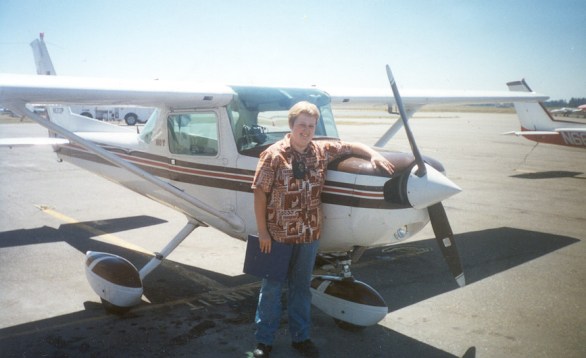
The plane was parked nearby and we got in without preliminaries. He got the engine started and we were off. With a lot of help I taxied to the runway and he made the necessary radio calls. It felt natural to steer with my feet, but I wasn’t very good at it. Soon I found myself at the end of a big strip of concrete, with my own hands on the controls, my own keister in the left seat, and I was happier than anything. He worked trim and flaps and had me push power in- almost before I knew it, I was flying! I was entranced with just the idea of being in the air.

He showed me how to keep the plane level and guided me through some gentle turns. At one point I was concentrating on keeping the wings parallel with the horizon- I looked over and noticed that Dave didn’t have his hands anywhere near the controls. He was unconcernedly talking about landmarks. I was impressed. All those years of dreaming of flight, and I was finally doing it! My face was set to Permagrin.

Dave handled most of the landing, explaining what he was doing as he did it, letting me do as much as I could-not much. Dreamily, I floated back into the airport office. A fellow pilot (I assume) asked Dave how the flying was since he got his pilot’s license back, after the violations. Dave hastily explained that the person was kidding- but I already knew, and thought it was funny.

Then I wrote out my check to Pearson Air, and received a small Cessna-logo logbook. Inside was the notation “.5 hours. Intro to 152. Level turns, landings, takeoff,” and the instructor’s signature complete with license number. I handled that little booklet as if it were a relic from a lost civilization.

My face was stuck on Permagrin for most of that week. I couldn’t wait to get back. Unfortunately though, I didn’t get in the air again for several weeks… one lesson and I was hooked. It hadn’t been scary at all, but natural and fun. My fear of heights was nonexistent in the air.

For my birthday I got enough for two lessons. As soon as I could, I called in my reservation…