
Designed and created by Josephine R. Unglaub
via Kitchen Cabinet. — lemanshots – Fine Pictures and Digital Art
Where Creativity Takes Wing

Designed and created by Josephine R. Unglaub
via Kitchen Cabinet. — lemanshots – Fine Pictures and Digital Art

This weekend, I’m featuring two of my books for free download on Amazon.com! Don’t miss this chance to score some free reading materials. I mean it’s not like your TBR list is too long already! Free download ends Sunday 2/12/17. From the Shadow What makes a man a monster? For too long Jacob has lived […]
Sometimes, we all wish our cats could talk. Then they could tell us where it hurts, where the annoying bug on the wall is, and what flavor of cat food they REALLY want for dinner.
Though we’ll probably never get cats to use more than a few words of human speech, we can talk to hem – and encourage them to communicate in return. Awareness of their communications styles can go a long way.
The number one thing you can do is talk to your cat, meaningfully. Cats are very intelligent and pick up on words fairly easily. At the same time, pay attention to their body language and look for signs of understanding. Make a fuss over them when they show they understand. Use relevant words when you are doing things – like talking about the kind of food you are setting down, pointing out the brush and talking about it when you are about to groom them, pointing out different body parts when you are petting them. “Here are your paws. Here are your ears. Here is your pretty tail.” Cats can be trained in much the same way you’d teach a baby.
Whenever possible, give your cat opportunities to communicate back. Demonstrate to them that they can make a difference in your behavior by communicating. For your part, pay attention – sometimes cats are very subtle. Look for significant glances, postures, gestures. Cats communicate a lot through body language.
I knew someone who encouraged her cat to communicate – she was in chimp language research and used the same techniques on her cat as she had with the chimps. By teaching her cat that communication mattered, and he could get what he wanted by communicating, she achieved a remarkable level of understanding. He even had modified sign language “words” he would use to talk back.
For example, my own cat will lick her lips and stare at me when she is hungry. That means “dinner.” So if I say “Are you hungry, Nezumi-chan?” and she doesn’t lick her lips at me, I know she doesn’t want to eat.
She’ll also reach up and pat my shoulder (from the surface of a table) when she wants my attention. Or she’ll boop my nose when she’s feeling playful. Sometimes she’ll gesture to things with her tail, using it like a finger. She’s learned more and more signals as she’s gotten older.
Pay attention to behavior and non verbal cues – be aware in general.
Talk to your cat frequently, and listen.
Be creative and encourage the use of gestures.
Name things when you do them.
Let their communication make a difference in your behavior.
When you can, give them choices. Help them see that communicating properly will get them what you want.
Soon, you’ll find that there are many fine shades of meaning beyond “meow!”
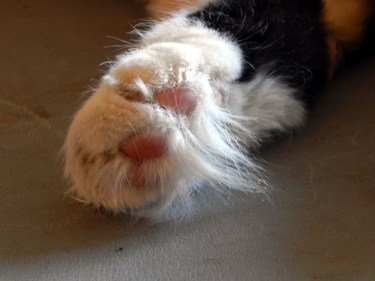
https://dailypost.wordpress.com/prompts/aware/
Within the next few days, my new eBook will be available. In it is all the material on the “Self Publishing” tab on my main site, plus a lot of additional information, clarification, and suggestions. I hope everyone likes it and finds it useful. It’s short, easy to read, and to the point. Best of all, it’ll be sold for only 99 cents!
Stay tuned, I’ll make another announcement when it’s available for everyone.

I don’t often share news but I thought this was rather startling. No matter what your stance is on climate change, I think you will find this article interesting.
Simply put, a UN official, Christiana Figuerres, recently admitted that the global warming agenda is really about destroying capitalism, not helping the environment.
The article further makes the point that with the capitalist system, human lifespans have doubled and working days have halved. Socialism doesn’t work, it leads to poor harvests, poor living conditions, and poor people.
I could rewrite the article and give my own thoughts on it, but really, it’s all here. I found this rather shocking and hope you read it too. The exact quotes and sources are all here.
https://www.armstrongeconomics.com/world-news/clim…
Everyone needs a good knife.
The knife is one of our oldest and most useful tools. The only tool older is the hammer, which originally became the knife when the rock being used as a hammer split into a sharp edge. With a knife and the right skills, you can rebuild society.
I’d be naked without my knife. It’s a very useful tool for daily life. However, there are some pretty strange ideas out there about knives. I’ve talked to people who seem to think I run a terrible risk of cutting myself because I have a knife. It reminds me of the mythical pistol that jumps out of the holster and shoots people on its own. However, this doesn’t happen. A good knife in a proper sheath is no danger when used properly.
As for those who fear knives instinctively, I think they are thinking symbolically. To them, knife = weapon and weapon = danger, with no thought of how a person might be using the knife, or what they might use it for. However, a good knife is a tool, and a very useful one at that! It’s a great feeling to be able to help someone or do something for yourself because you already have the proper tool for the job. There are even times when having something to cut with could save your life.
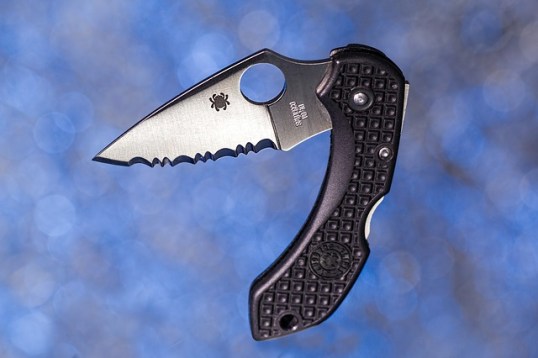

There are nearly as many kinds of knives as there are knife users. If you are a city dwelling person who likes to dress sharp, a bone or pearl handled penknife would be a classic choice. If you love the outdoors, a sturdy lockback or maybe a sheath knife with a staghorn grip could be good for you. If you’re of a more tactical mindset, there are many varieties of self defense knife out there, including ones that can be carried in wallets or as part of belt buckles. For people who are handy, the venerable Swiss Army knife or Leatherman l might be best. The possibilities are endless. I, myself, wear a neck knife. It hangs on a length of paracord and friction fits into a sheath. It’s unobtrusive but I can slip it inside my shirt if going to a place that doesn’t welcome knives. It’s my best friend when it comes to getting things done around the house, from opening packages to trimming an overgrown shrub.

When picking out a good knife, simplicity is supreme. When starting out, l look for simple designs. Don’t fall for the multi edged fantasy designs, for example – they may look cool but aren’t really good for much, and are often made with poor quality steel. Also, keep in mind that stainless steel can be a lot harder to resharpen. Carbon steel needs a bit more oiling and care, but it’s much better when you want to keep an edge on it. Keep your needs and goals in mind, and let that guide your decision on what kind of a knife to carry.
Below is a great article on choosing a pocket knife.
Every Man Should Carry a Pocket Knife
It’s easy to stay safe while using a knife, by following just a few simple rules. Because I’ve followed these rules, I’ve only cut myself once in thirty years! When I did, it was because I broke rule number four.
1. Maintain your Grip.
Make sure your hands and the knife are not slippery. Only use knives with good, solid grips. Don’t use a broken knife or one with a loose grip.
2. Watch your direction.
Cut away from your body. Keep your strokes careful and controlled.
3. Keep it sharp.
A sharp knife is a safe knife. It cuts better and doesn’t slip as much.
4. Use the right knife.
Different knives do different jobs. If you use a flimsy knife to chop wood, you might break yourself or the knife. The time I cut myself, I was trying to use a kitchen knife to carve a name into wood. If I’d used a jackknife or penknife with a strong, sharp point, I would have been fine.
5. Know your laws.
Knife carry laws vary widely state by state and country by country. Know the laws where you are, as well as where you travel to. If you are questioned about a knife you may happen to have, whether by police or private citizen, refer to it as a “tool” or “utility blade” to emphasize the useful qualities and reduce fear.
Once you have your knife, you want to keep it around for a long time. Like most quality things in life, a good knife needs care and maintenance. The following articles will help you keep your knife sharp and useful for many years.
You already know all the benefits to minimalism. Health, a cleaner home, less time spent reorganizing, less stress, etc. Sometimes it seems like you have to be rich to be minimalist. You really don’t, though. Not if you do it right. In fact, you can even save money. Here’s how.
Right now, this very moment, is a fantastic time to live in if you are interested in minimalism. Data storage is tiny and cheap, multi-function electronic devices are common, and almost every book, magazine or song is available for download. What once could only be stored in stacks and stacks of boxes or on shelves, can now be fit into a small pocket. That’s a real benefit for someone who is trying to be more minimalist.
I have been able to fit nearly my entire library into one SD card, and my music collection consists of four or five CDs plus several hundred songs in an 8 GB Mp3 player that cost $5 including shipping. My eReader cost $50. My computer maybe $300 and I’ve had it for about four years so far.
What has this done for me? Simplicity, even the basic level that I practice, allows me to support two adults in fair style on one income, even though I barely make over minimum wage. (Of course, I own my car, allowing low insurance rates, I don’t pay for cable, I found an apartment that doesn’t cost an arm and a leg, and my phones are $25 a line. That helps a lot. Even so, the principle is sound.)
My point here is that minimalism is easier to achieve with some of this modern technology and it can save you a bundle, in time, in storage space, and in money. It can be a great feeling when you walk into a neighbor’s house and think “wow, they have something on EVERY wall, and things stacked on EVERY surface. I couldn’t live like that!” Then you think “wait, I did live like that. I love my new life.”
I see it as freedom. Freedom from this:

You don’t have to turn your home into a monk’s cell to embrace minimalism.
Also, I won’t advocate getting rid of certain spare items. Sometimes stuff breaks, and you will be better off if you don’t have to buy a replacement right away. That’s what poor folk often do, poor folk like me, because we don’t have a spare wad of cash lying around. When you do keep spares, though, keep them in good order and keep them out of the way, such as in a labeled box. Know what you have, why you have it, and where it is. I have a few extra cooking knives in my drawer, and also my trusty (and old) eeePC in my desk in case the main PC has something happen to it. It doesn’t take up much space.
I took a hard look at my appliances and got rid of my food dehydrator, my juicer, and my printer. Print jobs are ten cents a page at the library on a high quality full color printer. My printer takes thirty or forty dollars to fill with ink, and then it expires before I even use it halfway. With the juices I drink, it would cost more to buy the fruit than just buy the juice. The food dehydrator was poor quality.
That brings me to another good guideline – if you buy something, buy the best quality you can afford. Ultimately, it costs less to buy better quality then to have something break. That saves money too, as well as headaches.
With these tips, and modified ideas from the innumerable other minimalism articles out there, you can save money and have a better life. The key is not to go ultraminimalist but simply be mindful in what you buy and why you buy it.
By contrast to the clutter I left behind, each bit of minimalism I find feels like this:

No matter what, the will to fight is ingrained in each of us.
When a child is born, they are usually not a passive bundle being pushed out of the womb. Not only do they struggle and fight for life, but the struggle itself helps the baby’s circulatory system work better. My spouse, who has midwifed fourteen births, says that the baby always fights for life. We are born fighting, and the fighting helps us live.
This also happens to butterflies. If you were to cut open a chrysalis to help the butterfly get out, the creature would not be able to fly. Their body would be large, their wings poor, shriveled things. Only through the struggle of getting out on their own do they gain the ability to fly. The squeezing of the small opening pushes the blood and fluids out of their body and into their wings, which expand during emergence, and harden shortly after.
Chicks struggle to peck their way out of the shell with nothing but their own strength and an egg tooth. Everything depends on this tiny battle. From the first moment of consciousness, the fight is on. Then, it continues in the struggle for food, territory, and breeding partners.
As humans, a lack of struggle weakens us. No weight lifter in the world got strong without lifting heavy things! There are no quick, easy answers. Everything requires effort. Handouts and welfare require effort too – but this time the effort is spent by the workers who pay for the welfare. The old saying is trite but true: There is no such thing as a free lunch. This is true in society, in nature, and everywhere else.
Life, all of life, is a war to be won with deadly consequences for failure. If we don’t fight disease, it takes over. If we don’t fight depression, it kills us. If we don’t continue to learn and grow, we slowly die. Though it might seem so, I am not being morbid – instead I am celebrating the toughness we all have inside. Many of us may not realize it’s there, but it is!
Even in birth, there is no safe space. Every day our bodies are resisting pathogens, bacteria, viruses, fungi. The moment our bodies die, they stop resisting, and the pathogens win. We rot. The very fact that we are still alive means we are winning the fight for one more day.
What will we do with our victory?
Tired of paying high prices for yogurt? Interested in being more involved with your own food supply? Sick of tiny containers and lots of artificial ingredients? Don’t have the time for a complicated cooking project?
Try automatic yogurt!
It’s really easy.
All you need is milk of some kind, a spoonful of unsweetened yogurt to use as a culture, and a Thermos style insulated bottle.
That’s it!
The process is simple and even a little fun. Just heat up the milk to just above body temperature, then stir in a spoonful of your favorite plain yogurt. Finally a use for those tiny containers that go on sale at the grocer’s. If you use a microwave to heat the milk, add the culture after you already have it warm.
You can use nonfat dry milk to make yogurt, then you can just use warm tap water to make your milk. Mix it double strength for a really awesome texture.
Then, cap the Thermos tightly and set it in a warm place overnight. I usually use the top of my hot water heater. In the morning, you should have a nice amount of smooth, thick yogurt.
You can add fruit or honey to your new yogurt, mix it into recipes, use it as a substitute for sour cream, or make it into sauces like tzatziki. It can be made into a type of cheese, too, if you drain it for several hours in cheesecloth. Make sure to save the whey for adding to soups or bread.
If you’re looking for a wide mouthed Thermos bottle, it’s best to choose one that’s made of stainless steel. You can use other kinds but plastic holds odors and bacteria a little too well, while steel is easy to sanitize. Here’s a good example for you.
Some people also use a Crock Pot style slow cooker, which is great for when you need large batches, like if you’re making yogurt cheese. Here’s a nice, high quality, low cost example.
If you have an issue with mold, make sure your container is well sanitized with a weak bleach solution. Clean every nook.
If your yogurt won’t set, either your culture (the spoonful of yogurt) is weak, or you killed it with excessive heat or cold. The best temperature is about body tempoerature, maybe a little above.
If your yogurt tastes funny, clean your container.
Almost all problems with yogurt can be corrected by cleanliness, waiting a little longer, or getting the right temperature. The key is to remember that the bacteria that make yogurt are living organisms, and make an ideal environment for them to grow.
(Disclaimer: If you follow the links to Amazon and decide to buy something, I get a small amount from the purchase. There’s no additional cost to you. I looked for the best value for the money and shared that, rather than picking the most expensive thing.)









 Mindflight
You must be logged in to post a comment.